Showing posts with label hype. Show all posts

Friday, April 13, 2012

Correlation, Causation and "Links"


What does it mean when a medical study shows correlation? Does it show cause and effect? What about causation? What does it mean when the media announces another "link" to autism? What about those confounding variables. There are some words we need to define before we delve any further into the world of statistics, media and hype.


image via: http://www.rimmkaufman.com/content/bell_curve2.gif


Causation- The action of causing, as in the relationship of cause to effect, something that produces an effect.  "Even when you change something, you cannot remove the effect without removing the cause."
Correlation- the degree in which two or more measurements on the same group of elements show a tendency to vary together. Just because they vary together you cannot assume causation.
Link- this is not a statistical term, it is used by the media to show a relationship.
Statistically significant - generally, the result would happen by chance less than 5% of the time.
Confounding variable/factor - something that correlates either negatively or positively with the independent and dependant variables.
image via: http://www.experiment-resources.com/correlation-and-regression.html
What we are looking for in these studies is cause and effect. The recent report about the "link" between obesity and autism is more hype than science. What they found was a correlation between having children with autism and women having diabetes. Women who were overweight were more likely to have metabolic disorders, defined in the study as obesity, diabetes and hypertension. The reports of the study focused on women, obesity and having a child with autism, instead of diabetes. Although diabetes had a correlation that was statistically significant in the findings, the correlation of having a child with autism to hypertension and obesity was not statistically significant, meaning that it did not occur more than it would by chance. Obesity was not cited specifically as a correlative or causative factor. Obesity is generally defined as having a BMI score of over 30. (I did not find out if they used this exact measure.) 
What about regular weight women with diabetes and hypertension? Do they have a higher risk of having children with autism? How do they fit in with these findings? The sample pool was over a thousand children, and still they only found a "loose association," to metabolic disorders, (as the study's writers put it.) This tells us that they are not very confidant with their results or they would have stated it differently.  It does point to an interesting direction for more research, but as it stands it doesn't say much and it is difficult to tell if there is a confounding factor involved.
There are many factors involved a child being diagnosed with autism.  Another report stated recently that older fathers (they defined older as over 35,) had a greater likelihood to have children with autism.  If you look further you see that "greater likelihood" is really a correlation not causation, and that the three small studies involved are again showing possible directions for more research, rather than an answer to the question: Do older fathers have more if a chance of having children with autism?
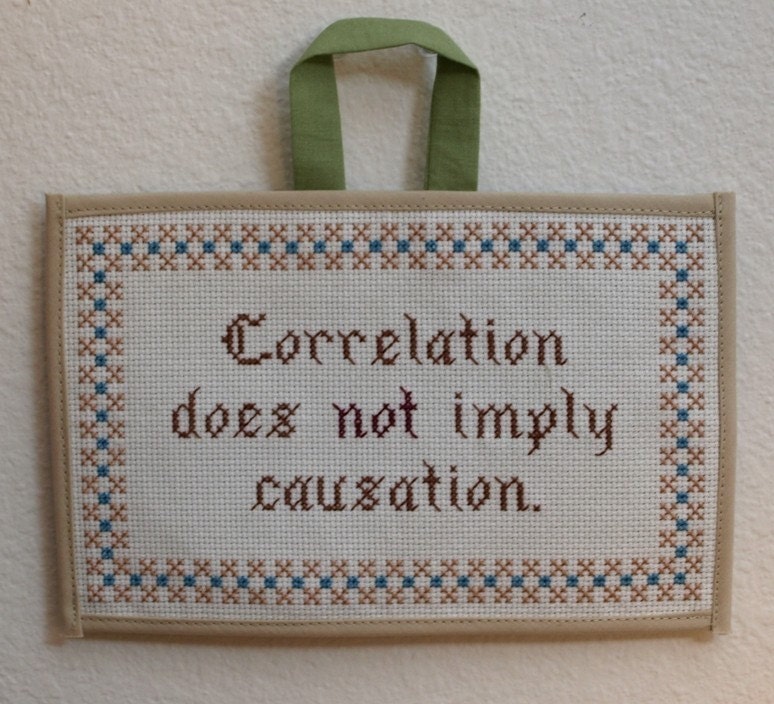
image via:http://www.etsy.com/listing/45771938/correlation-does-not-imply-causation

We as parent and media consumers need to be savvy to the use of statistics in media reports, especially ones announcing the latest cure or cause for autism, (or the special need your child has.)  Read the reports with a critical eye and keep these definitions in mind.  As I have said, statistics aren't scary, but they can be a powerful tool to either instill confidence or fear.  I hope this post helps make things clearer and less fearful for you.


Resources:
http://pediatrics.aappublications.org/content/early/2012/04/04/peds.2011-2583.abstract


http://www.eurekalert.org/pub_releases/2012-04/uoc--mod032812.php


http://www.cbc.ca/news/health/story/2012/04/05/autism-genetics.html


http://www.nimh.nih.gov/about/director's blog/2012/the-new-genetics-of-autism


http://www.av8n.com/physics/causation.htm


http://dictionary.reference.com/browse/causation


http://dictionary.reference.com/browse/correlation?s=t
Statistics Demystified by Stan Gibilisco
Statistics for Dummies by Deborah J. Rumsey

Friday, February 17, 2012

Latest from the Bedside Book Stack

image from : http://www.psychologytoday.com/files/u894/stack-of-books.jpg

Here are the latest from my book stack. My top recommendation of autism in fiction is With the Light. It is a Manga/Graphic novel type of  book and it takes a little bit to get used to reading a book from the back cover forward, but once you get hooked into the story you don't even notice. It does a good job of portraying the frustrations, fears and hopes in discovering your child is different. You may need to keep some tissues handy, not only because it is sad at times, but because it is hopeful too.
http://www.goodreads.com/book/show/2111326.With_the_Light


With the Light: Raising an Autistic Child (With the Light, #1)
image from:http://www.goodreads.com/book/show/2111326.With_the_Light


Another favorite is The Einstein Syndrome.


image from: http://ia700808.us.archive.org/zipview.php?zip=/21/items/olcovers29/olcovers29-L.zip&file=299149-L.jpg
This one is good if you have a kid who has language delays, and atypical development with splinter skills. The author is a little hard on some speech therapists, but a good speech  language pathologist (SLP) will tell you that some of what he says is true. It is important to get one who has a good reputation, (not just experience,) for working with kids with ASD or whatever deficit your child has specifically.

The Autism Mom's Survival Guide (for Dads, Too!)  leaves you feeling pretty good. The author encourages you to take care of the rest of your life: your marriage, your time for yourself, and your other kids. 

The Autism Mom's Survival Guide (for Dads, too!): Creating a Balanced and Happy Life while Raising a Child with Autism
image from: http://www.goodreads.com/book/photo/7132925-the-autism-mom-s-survival-guide-for-dads-too

The geek scientist in me made me pick up this book:
 The Panic Virus: A True Story of Medicine, Science and Fear.  It investigates the fear our culture has acquired towards vaccines. The author interviews the players in this drama, and investigates the mystery of how we came to question vaccines and their safety.  Who decides what is true? Is it science, the media, celebrities, or popular opinion?  http://www.goodreads.com/book/show/9691004-the-panic-virus


Fire Drill

http://www.goodreads.com/book/show/7528667-fire-drill
Fire Drill was a lifesaver for us. It is a basic social story in book form. I know SensiGirl has trouble with fire drills. During the first one at preschool, SensiGirl was so overwhelmed they had to put her in the wagon and roll her out.  I knew transitioning to Kindergarten was going to be tough and that a fire drill would be one more thing to put her off of school.  We read this book every night for three weeks before school started. She still had trouble, but she  walked out on her own rather than having to be carried or rolled out. Progress is progress, even if it isn't always pretty.

I like to garden, but SensiGirl still puts inedible things in her mouth. This is called pica. Last summer I discovered this gem: Wicked Plants. An interesting read from a gardening and historical point of view, and good stuff to know when you have kids that still don't know the poisonous plants from the good ones.
http://www.goodreads.com/book/show/6106482-wicked-plants

image from:  http://www.amystewart.com/images/wickedplants.jpg


I am always looking for good books to read, so if you have recommendations please share and we can get the word out to others about informative and helpful books.