What does it mean when a medical study shows correlation? Does it show cause and effect? What about causation? What does it mean when the media announces another "link" to autism? What about those confounding variables. There are some words we need to define before we delve any further into the world of statistics, media and hype.
 |
| image via: http://www.rimmkaufman.com/content/bell_curve2.gif |
Causation- The action of causing, as in the relationship of cause to effect, something that produces an effect. "Even when you change something, you cannot remove the effect without removing the cause."
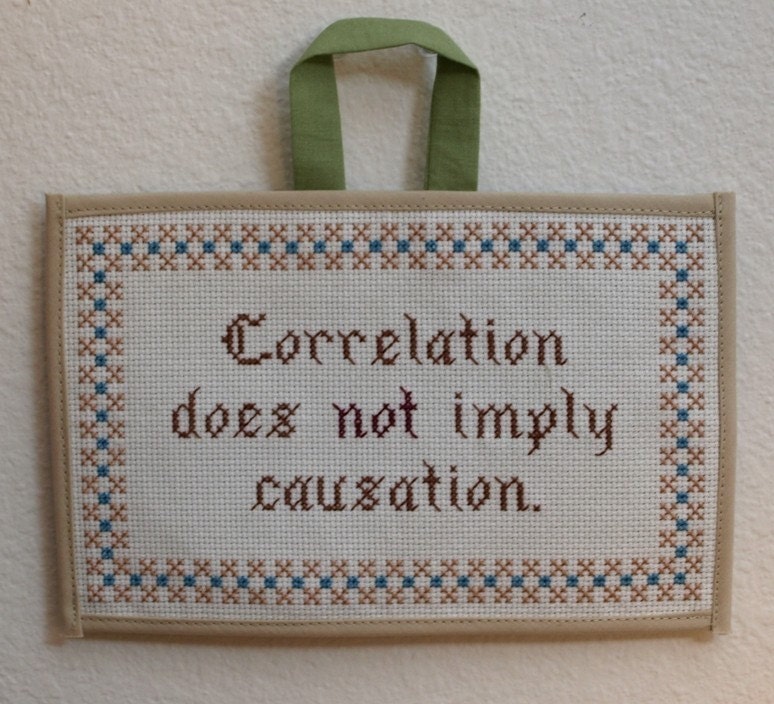
Correlation- the degree in which two or more measurements on the same group of elements show a tendency to vary together. Just because they vary together you cannot assume causation.
Link- this is not a statistical term, it is used by the media to show a relationship.
Statistically significant - generally, the result would happen by chance less than 5% of the time.
Confounding variable/factor - something that correlates either negatively or positively with the independent and dependant variables.
 |
| image via: http://www.experiment-resources.com/correlation-and-regression.html |
What about regular weight women with diabetes and hypertension? Do they have a higher risk of having children with autism? How do they fit in with these findings? The sample pool was over a thousand children, and still they only found a "loose association," to metabolic disorders, (as the study's writers put it.) This tells us that they are not very confidant with their results or they would have stated it differently. It does point to an interesting direction for more research, but as it stands it doesn't say much and it is difficult to tell if there is a confounding factor involved.
There are many factors involved a child being diagnosed with autism. Another report stated recently that older fathers (they defined older as over 35,) had a greater likelihood to have children with autism. If you look further you see that "greater likelihood" is really a correlation not causation, and that the three small studies involved are again showing possible directions for more research, rather than an answer to the question: Do older fathers have more if a chance of having children with autism?
 |
| image via:http://www.etsy.com/listing/45771938/correlation-does-not-imply-causation |
We as parent and media consumers need to be savvy to the use of statistics in media reports, especially ones announcing the latest cure or cause for autism, (or the special need your child has.) Read the reports with a critical eye and keep these definitions in mind. As I have said, statistics aren't scary, but they can be a powerful tool to either instill confidence or fear. I hope this post helps make things clearer and less fearful for you.
Resources:
http://pediatrics.aappublications.org/content/early/2012/04/04/peds.2011-2583.abstract
http://www.eurekalert.org/pub_releases/2012-04/uoc--mod032812.php
http://www.cbc.ca/news/health/story/2012/04/05/autism-genetics.html
http://www.nimh.nih.gov/about/director's blog/2012/the-new-genetics-of-autism
http://www.av8n.com/physics/causation.htm
http://dictionary.reference.com/browse/causation
http://dictionary.reference.com/browse/correlation?s=t
Statistics Demystified by Stan Gibilisco
Statistics for Dummies by Deborah J. Rumsey
