Showing posts with label ASD. Show all posts

Thursday, October 16, 2014

Tuesday, September 30, 2014

Taciturn Tuesday: Asperger Experts


Information and advice from those who have experienced life with Asperger's.


image via: http://www.aspergerexperts2.com/


Wednesday, October 9, 2013

Bullying in Schools: Elementary to Middle School, Our Experience


image via: http://www.startribune.com/local/stpaul/184573741.html

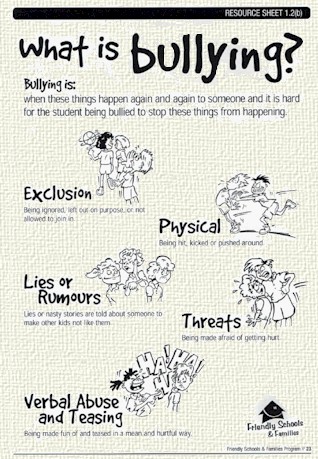
Bullying in middle school starts in the first week of classes, when students are establishing their status and friendships. They may try bullying a student to impress others or just to make themselves feel better.
The teachers and administration need to be proactive in this issue. To announce their expectations for the students' behavior as much as they emphasize the expectations for homework.
When bullying occurs, teach the whole class what the expectations are, again. Bullying is not acceptable, the parents of the bully should also be taught what the expectations of behavior are for their children.
Peer mediation fails at all grade levels as it gives the bully a platform to intimidate again.
The attitude we experienced of the middle school staff, specifically, the social worker, towards verbal bullying is weak and ineffective. It was stated to me that “well, at least he's not in danger of getting stabbed or shot, the kids are just using words...” Word will and can drive a student to suicide as discussed in several articles in Psychology Today :


and also here:

The school districts policy toward bullying is intentionally vague: 

The District cannot monitor the activities of students at all times or eliminate all bullying. However, to the extent such conduct affects the educational environment of the school district and the rights and welfare of its students and is within the control of the school district in its normal operations, it is the District’s intent to:
• Prevent bullying by teaching and modeling positive behavior, and
• Investigate, respond to, remediate, and discipline bullying behavior that has not been successfully prevented.


image via: http://threatormenace.com/2012/06/14/exclusion-the-ties-that-bind-us/
The social worker's solution was to observe the classes for the bullying behavior. What bully is going to engage in that behavior with an extra set of adult eyes watching? The result was she and other adults saw no peer interaction with my child. So basically, if they are not bullying him they will ignore him and exclude him.

image via: http://katyshamitz.blogspot.com/2011_07_01_archive.html

 I find the lack of a coherent bullying policy negligent on the part of the school district. I have been aware of the need of a policy for student behavior since my child was in the first grade. We moved schools in 3rd grade because of the ham-fisted way our neighborhood elementary school handled the situation. It was so bad that I began to feel bullied by the principle. I was called and yelled at by the principal. I was told not to talk to the other children without the consent of the parents when all I had done is model for my son (who was yelling at his bully,) to state calmly to the bully what behavior was bothering him. The end result was I was informed that bullying can go two ways and my child and I were part of the problem. 
 
image via: http://www.thehappymd.com/blog/bid/284600/Physician-Wellness-Why-It-s-Such-a-Struggle
This was not the case. My child was systematically bullied by the other child multiple times and the school had been made aware of the problem previously. This was the second year that my child had been bullied in their school. Rather than beat my head against a wall constructed by an insensitive, ignorant administration at the school, I moved my son to a different school within the district. We still had some trouble with bullies, but it was dealt with in a explicit and efficient manner and it was made clear to the student and parents what was acceptable behavior. I have had to use moving schools as a strategy twice now in his school career to deal with bullying, and he is only in 6th grade. 

image via: http://murray.spps.org/aboutus

I have instructed my child that for the remainder of the time he is in school, if he is bullied he is to walk away from the bully. He is to tell the teacher he is being bullied and wants to go to the office, once there he is to tell the staff that he is being bullied and he wants to go home, and I will come and pick him up. This not only makes the teachers aware of what is happening in their classrooms it makes the school administration aware of it too. A bonus is it tracks the class it occurred in and my child doesn't have to endure an entire day of being bullied. 

resources: Saint Paul Public Schools Policy 505.00
 Adopted: 8/21/2012, page 84/164
SPPS_POLICY_MANUAL_REV._2008-ALL.pdf


Friday, September 20, 2013

Transitioning into Middle School - Failure


image by MuffinPoodle via: http://muffinpoodle.deviantart.com/art/Mama-Bear-316649305
Transitioning your special needs kid to Middle School is a daunting task. Having no way to make it successful, I was left searching for a new plan. I had tried to get my son ready for the transition to Middle School far ahead of time. We worked on it with his therapist and his social worker at his elementary school. No amount of preparation could have saved us from the result of poor planning by the school district, lack of a coherent bullying policy and lack of professionalism. The following is from my on-going notes documenting his transition to Middle School.

image via: http://drdeborahserani.blogspot.com/2008/08/hope-therapy-and-resistance.html
I should have had an idea of what was to come when I tried and tried to get a representative from the middle school to attend  the IEP meeting in the Spring before the transition for planning purposes.
After my insistence, we finally got a middle school staffer to attend, but I was not able to get Random's schedule of classes before summer started. It is documented in his IEP that he needs to have a written schedule for him to refer to so he can feel secure in knowing what is going to happen and therefore reduce anxiety. We did take a preliminary tour and got a map of the school before summer break.
image via: http://theeducatorsroom.com/2012/10/when-teachers-leave-the-profession-is-it-time-to-make-a-change/
I called the school once teachers returned from summer vacation; we needed Random's schedule, to take the tours and get his locker as planned.  When I reached the school to complete these steps with my middle school contact, I was told she had left the school. In fact, the SERC,(Special Education Resource Coordinator,) social worker, Autism Spectrum Disorder (ASD) case manager and principal were replaced and/or new to the school. I worked for two weeks before the start of school to get all transition pieces in place. I asked for tours to go over where he would be when, (hard to do without a schedule,) and a locker assignment with a lock to practice on so he would be comfortable going to his locker when all the other kids were swirling around him. I requested a five minute pass as many other special education parents suggested. I also tried to get Random his homework help as outlined in his IEP too.
image via: http://www.keepcalm-o-matic.co.uk/p/keep-calm-and-choose-both-2/
I was asked by the new SERC what was more important to me, social or academic development? She told me I would have to choose. I was also told that there was a problem with the scheduling "algorithm" and that all the student schedules were having to be done by hand. (I didn't really believe that.) I was not able to get follow through on even one part of a transition plan until the last work day before school started when I was told Random could be in the Transitions class first hour of each day. So he knew he where he was supposed to go for the first hour of the first day. That was all I got from them for proactive planning and transitioning. I asked for 5 minute pass for Random as he was having anxiety about his lock on his locker. Our request was deferred, we were told he would have to show a need for it by being late.
image via: http://www.getholistichealth.com/10628/helping-your-children-overcome-relocation-related-stress/
As much as I tried to get Random's schedule, he did not get his class assignments until halfway through the school day on first day of school. Needless to say Random didn't attend school that day. Apparently they re-ran the scheduling program and were able to get the kids and teachers the necessary information they needed to go about their day, by the second day of school.
There is no homework help on his schedule, even though it is written in his IEP. He will have to show he needs more academic help by getting a D or worse in his classes. I was informed that it would be addressed by the time we would have parent/teacher conferences. Instead, he has what is called Transitions class, this is his only option for some extra help. Essentially it is a smaller first hour class to help get him organized for the school day. 
Random attended school Wednesday without any incident. Thursday he was bullied in science class. I reported it to school the next morning, when Random tells me what was said to him in class. Random attends school Friday, he's bullied again, this time by multiple kids in multiple classes. I get call back from science teacher apologizing for the bullying in her classroom. She says she will keep an eye out for Random from now on. Random has anxiety so severe he cannot attend school on Monday. That is when he reports to us the bullying that happened on Friday.

image via: http://www.noexcuseshr.com/2011_04_01_archive.html
I go to school with Random the following Tuesday to devise a plan to keep Random safe from bullying during the school day. I ask to meet with the Social worker, she cannot be found or contacted, I wait. The SERC is in a meeting and is not available. The speech/language specialist arrives to help me find the social worker. The speech teacher said the thinks the social worker has a walkie-talkie so they can contact her. (I find out later that the social worker does have a walkie-talkie, but she leaves it on her desk, because she doesn't want to carry it around with her.) 

Once we found the social worker we all sat down in her office and I explained we are moving Random to K-12 on-line school  and will need discuss transition and IEP hand over before the move. We then start to discuss the the bullying and I am questioned, "Which classes are the problem?" I reply that all classes are the problem except Transitions, due to it being a Special Education class. Also, his Transitions teacher is supposed to be his case manager as she is a designated ASD teacher. The social worker still doesn't know definitively by the second week of school who his assigned case manager is, and that it needs to be a designated ASD teacher.

image via: http://arthuride.wordpress.com/2011/11/23/psychology-of-suicide-and-bullying-and-how-religion-schoolclassmates-and-family-affect-both/
I convey that it is the utmost importance that my child is kept safe from bullies. I am told by the social worker, “He's not in any danger of being shot or stabbed, the kids might use words...” I pointed out that was not acceptable, as bullying can be bad enough for children to harm themselves.
We agreed there would be another staff member in each of the day's remaining classes to observe. Teachers would then be instructed as to how to reduce opportunities for bullying based on the day's observation.
Also I requested the 5 minute pass again, and was told that it shouldn't be a problem, although he still didn't received one. I requested the pass a third time the following week. Finally, teachers were notified by the social worker that Random gets to leave class 5 minutes early, and a permanent pass was put in his planner.

image via: http://www.examiner.com/article/federal-judge-holds-bullied-special-education-student-denied-education
I had a chance to talk with the principal when she called back my husband from his complaint call.  I reported the shot or stabbed comment. The principal told me the bully had been identified to staff by my son, and the student was talked to. She said there was "...resolution to the problem, now that the first layer of intervention was completed." I was told by the social worker that the principal had told her that there was no more action needed by her. I do not agree with that assessment.


I talked to the social worker on Wednesday and was told that there was little or no peer interaction seen during the observations. I was told that there is an education assistant in his 7th hour class for an extra set of eyes for social interactions. The solution suggested for now is to have the teachers write a comment each day as to how things went, essentially a parent/teacher communication book. The social worker then focused on homework workload, and told me that there would be no homework for reading and math classes, no homework from his first hour class either. I was to check the organizer/notebook for any other homework assignments. Teachers would be instructed in using the communication notebook. As of a week after this apparent instruction, I have seen one comment in his organizer/notebook: " Good Day!" followed by the teacher's name. This is the school's idea of homework help.

image via: http://www.telegraph.co.uk/gardening/9540859/Dahlias-How-the-once-naff-flower-has-made-a-dazzling-comeback.html
One bright spot in all of this was being contacted by the social worker from Random's elementary school to ask how Random was doing in his transition. I explained it was not going well. She offered to be a resource for middle school since she is familiar with Random and to help them get to know him better. I shared her contact information with the middle school social worker.  I will also use her as a resource for his transition to K-12, as the staff in the middle school have no clue as to how to help Random through a transition.
image via: http://www.homeschool.com/resources/K12/default.asp


Tuesday, September 17, 2013

Taciturn Tuesday: Autcraft Fundraiser

image via: http://www.gofundme.com/3ow7hw


Plus

image via: http://my2.tupperware.com/tup-html/fundraiser.html
Equals


Friday, September 28, 2012

The Personal Shopper: An Underused Resource

image via: http://www.resumecoverletters.org/interviewattire/
I had a session with a personal shopper at the local thrift store, ARC Value Village. It got me to thinking about using the different resources in our community. I think that for neurodiverse teens and young adults, when looking for a job or going to a college interview, a personal shopper finding some appropriate outfits would be a very beneficial way to spend an hour or so of their time.

image via: https://www.se-alliance.org/member-news/member-spotlight-arcs-value-village

My sister and I decided to do the personal shopping experience as a birthday present for me. I filled out an online preference form for styles and sizes, (including my weird clothing fiber allergies.) We filled out the form about a month before our visit to give our shopper, Michelle, enough time to find some nice outfits for our visit. When we arrived we were ushered to our reserved fitting rooms and she had a rack of clothes ready for us to try on. She not only had clothes, but she included some shoes and belts as well as other accessories. When we figured out how to fit my body type she pulled some additional choices for me to get a whole outfit that would work for me.

image via: http://minnesota.cbslocal.com/tag/arc-value-village/
She didn't pressure me to buy anything; in fact she suggested that some items I tried on might not be a good choice for me, since the fit was off. She gently helped me expand my thinking about what items would work for me to attain my goals for my appearance.
I know from shopping with Random Guy that if you just pick things for him without considering what he wants, he will not wear the items. The objection could be about a texture, fit, or even a sound that the fabric makes. He hates his raincoat, since it "swishes" when he swings his arms when he walks. He would rather get a little damp than wear it. It now resides in the bottom of his backpack, (for downpours only.) You can explain all these preferences before you have your visit with a personal shopper and then the items are already screened for you.

image via: https://www.facebook.com/arcsvaluevillage?v=feed&story_fbid=159906898582

You may think a personal shopper is not in the cards for you, because you may not have a huge wardrobe budget or since you don't shop the fancy stores. If you look, you can have a great experience with one either through the thrift store like I did or as a service provided by some stores, (bigger department stores may provide the service, sometimes for free.)

image via: http://www.collegemagazine.com/editorial/23/interview-attire

We are always trying to teach our kids the ins and outs of personal interactions and personal appearance, I can't think of one that would be more helpful as you launch your kid into the working world. Since ARC's mission is to help people with intellectual and developmental disabilities, it is a perfect fit for helping with the transition to college or employment.

Resource:
arcsvaluevillage.org/personalshopper

Friday, February 24, 2012

Inclusion and Mainstreaming: The Basics


image from:http://2.bp.blogspot.com/_eghZ7rKsiiE/SH-EE9dtv
TI/AAAAAAAAAAM/lNeIG4w0NKE/S240/files.jpg

We didn't think that Random Guy needed a special education  preschool classroom. He was participating in his preschool ECFE classes and the neighborhood community education preschool with few problems. They suggested an ECSE inclusion classroom for his preschool year to work on some of his social delays and attention issues he was having in a regular classroom.  We found inclusion was the right balance for him.  By the time kindergarten came around we put him in a regular education classroom with supports. I don't even know if they knew what they were doing for us was a type of inclusion;  we decided for Random Guy to go to the neighborhood school and they had the support he needed at the time.
SensiGirl had too many issues  to be successful in an inclusion classroom in preschool, but she is mainstreaming into a regular kindergarten class that includes another kid with ASD.  Here is a handy visual to demonstrate the differences between the two concepts:

image from: http://www.unco.edu/ncssd/Presentations/jackson/pbs/ui/slidepic1.gif
Inclusive classrooms do more that integrate the children with disabilities into the classroom.  It focuses on the children's abilities, learning is improved by both general education and special education students, meaningful friendships develop, as well as developing a sense of empathy for others. Those and more reasons can be found here:http://inclusiveclass.blogspot.com/2012/02/10-reasons-for-inclusive-schools.html

Federal Laws don't require inclusion, but the IDEA and Section 504 of the Rehabilitation Act of 1973 say the a student must be placed in the least restrictive environment and the schools have to provide for the education of each student with a qualified disability.  What the laws don't say is how to provide this environment. Inclusion grew out of these and other laws and now we are finding ways for doing this effectively.
There are generally two methods of inclusion.  There is the Push In  method, where the special education teacher comes into the classroom bringing materials if needed and to provide instruction.
In the Full Inclusion method the regular education teacher and the special education teachers are partners in the classroom.  The special education student participates in the general education classroom with supports from the special education teacher.
Inclusion isn't for every student, or every school, but mainstreaming has its drawbacks too. One attitude that is prevalent in mainstreaming is the student has to earn their place in the general education classroom by being able to keep up with the pace of the other students.  To participate in inclusion, the student only has to show that they benefit from being in the general education classroom.
Inclusion is a teaching concept of growing importance and teachers need training to get it to work for them in their classrooms. Our  Family Friend Graduate Student  is a great advocate for inclusion classrooms and is getting training in both early childhood education and special education so she can put together an inclusion classroom of her own.

resources: http://www.weac.org/Issues_Advocacy/Resource_Pages_On_Issues_one/Special_Education/special_education_inclusion.aspx
http://specialed.about.com/od/integration/a/Inclusion-What-Is-Inclusion.htm

Thursday, February 2, 2012

It's a Start

photo from: http://taxdollars.ocregister.com/files/2011/03/Path2.jpg
Special education, advocacy and support are what this blog is about.  Being a mom with a girl with an ASD diagnosis  has changed things for me. I have found that being a mom of a child in special education is sometimes lonely.
You may have the love and support of your family and friends, but very few of us really know  from the start what to do to get what your child needs from school and the community.
 The moment of diagnosis changes your path in parenting.  You are now on a different track from your friends and neighbors and will have to find a way to navigate an unfamiliar path through to your child's adulthood. I am not there yet. My daughter just started kindergarten this year. I also have a son who has an IEP for ASD. He is mainstreamed in a 4th grade class now.
I have some experience, but I do not know it all. This is a place where we can share information and support each other. I will be posting various links and information that I have found helpful. My next post will most likely be about iPad apps that have worked for us. I will also post about IEPs, transitions, and what therapies we have had experience with so far.