Showing posts with label advocacy. Show all posts

Wednesday, September 17, 2014

Special Education Parent Skill Set

image via: http://www.glasbergen.com/wp-content/gallery/creative/thumbs/thumbs_cre23.gif

Sitting in the waiting room at one of my kids' therapy appointments, I met a mom who is just starting her special education journey. Our conversation made me realize that being a special education parent you evolve a certain skill set. With practice you get good at some things that may not come naturally to you and are not taught. Most of us learn this by trial and error.


image via: http://studyhungary.dev.xtremedia.hu/upload/images/comm.jpg

Communication - Once you are a special needs parent it is important to communicate what your child needs and to advocate for them. You are going to have to communicate with lots of different professionals. Make sure you understand what they are telling you and ask lots of questions. Also make sure they understand what you are telling them. I send a getting to know you letter to my children's educators every year. This year I also discovered it was helpful to share that information with the transportation staff too.


image via: http://www.theopennotebook.com/wp-content/uploads/2011/10/ask-215x300.jpg

Ask for what you need - If your child needs something, the sad truth is you are going to have to ask for it. There may be offers for help here and there but if your child or family needs something from a school district, or the local government you most certainly have to ask. The honest truth is that's how they keep their costs down. They sometimes can't help you UNTIL you ask, so ask.


image via: http://tweakyourbiz.com/management/files/shutterstock_187332701.jpg

Hold the professionals accountable- If you don't understand what is going on with your child at school ask for some explanation. Once your child is labeled and designated special needs you get either an IEP or a 504. As a parent of a child with an IEP you can call a meeting to discuss their services at any time of year. If the school district withholds information or services, remind them of your rights. Wrightslaw.com is a great resource for what you can legally advocate for and what you should expect from the professionals serving your child.


Persistence -  Sometimes you will have to ask more than once, or someone will have a bad attitude when you deal with them, and you need to devise a work around. You will have to continue to advocate for your child even in the face of an adversarial attitude and ignorance. Keep trying and keep looking for a solution or resolution. Resources are limited and sometimes they count on you giving up. Don't give up.



Problem solving- I have been a noodler since I was a kid, so problems solving and puzzling out solutions is a natural state for me. Sometimes the problems are bigger than your abilities or experience. Look for solutions in other places if you are not getting what you need from your local school district. Ask for help from local advocacy agencies like your local autism society or your local version of PACER.  I home schooled my son with K-12.com last year when his transition to middle school failed. I also pulled my daughter from the school district when they targeted her autism program for elimination. Even though her school placement last year was far from ideal, it positioned us to be one of the first families to attend the new autism school in the special education district that serves the northern suburbs of our area.


image via: http://media-cache-ak0.pinimg.com/736x/89/ec/eb/89eceb77fa0f69aa49fa8aa4775a09e2.jpg

Pick your battles/Know when to cut your losses-If the school district has decided that all special education students belong in the general student population no matter what their needs, there isn't much you can do about it besides a lawsuit. That takes time, (which you don't have since your child's development is at stake,) and money. You may be able to win a legal battle, but sometimes its just best to look for your solution somewhere else. I am not saying not to go through the steps of advocacy. Talk to your school board, the special education department, even your local newspaper. But sometimes you cannot change the tide and you need to devote your energies elsewhere.


image via: http://lisbethcalandrino.com/wp-content/uploads/2012/10/networking1.jpg

Networking - Look for other parents either online or in your school district. Having a special needs child can be isolating. There usually aren't enough of us concentrated into our neighborhoods and with enough free time to form a local support group. You may be lucky and get someone from the school district to host a monthly support meeting. You should look to see if there is a special education advisory council in your school district and join. This is where you will get the information of what the school district plans are for special education in the coming months or years.
The online special needs community is there for you 24/7 or at least as often as some of us can get to a computer. There are Facebook pages and groups, as well as lots of blogs to follow (Snagglebox has been one of my favorites.) You may be overwhelmed by all the information available about your child's diagnosis at first, but with time you will find your trusted information sources. The Thinking Person's Guide to Autism, Autism with a side of Fries,  and Shut Up About Your Perfect Kid are some examples of my favorite special needs communities online.

Monday, April 22, 2013

1 in 50? It is Time for Autism Advocacy

 
image by Jay Javier via: http://eastofherewestofthere.blogspot.com/2011/05/autism-accept-different.html

The big news this year for autism in April is that the emphasis has changed from Autism Awareness to Autism Acceptance. If your life has been touched by someone with autism, then you are plenty aware of autism. The newest study to come out is that the incidence of autism is at 1 out of 50 children will be diagnosed with autism spectrum disorder. 
 There has been enough media coverage of autism that I think acceptance is the important direction to follow. There have been many irresponsible stories about autism. Too many to cite here, one has been the vaccine debacle, which millions of dollars have been diverted from truly helpful research to proving a irresponsible "doctor" wrong. Another issue that seems to keep coming up is the media's fascination with linking mass violence with autism. They tried to make a connection with the Colorado movie theater shooter and also with the Newtown shooting. This is not only irresponsible it is dangerous. It is akin to bullying.
image via: http://ok.gov/sde/faqs/bullying-frequently-asked-questions
 Most individuals with ASD (autism spectrum disorder,) have been bullied. Not only that but since they may lack the social skills or language to report it, it often happens repeatedly before the proper authorities have been made aware of the situation. The proper authorities have to be educated on how to deal with bullying of ASD individuals properly. People living with autism can expect to be bullied repeatedly over the course of their lives. It is imperative that we teach our children to report when they become targets for bullies. 
image via: http://www.frameworks4learning.com/workplace-bullying.html
 It is very important to learn to advocate and to teach our children how to advocate for themselves and to be resourceful in their dealings with those who would like to take advantage of their situation.
So I would propose that we not just focus on awareness, or even acceptance but advocacy for ourselves and our children. 

http://bigstory.ap.org/article/health-officials-1-50-school-kids-have-autism

Tuesday, February 19, 2013

Monday, October 8, 2012

Writing an Effective E-mail to School

As much as you would like to, do not send this:


image via: http://harrypotter.wikia.com/wiki/File:Howler.JPG


There comes a time when you are going to have to communicate your concern or displeasure to the school. There are a few things you will want to cover in your missive. 
I have had to write several and will share with you some examples to show you what to try to achieve.
MPR photo/Tom Weber    image via: http://minnesota.publicradio.org/display/web/2012/09/04/education/school-bus-delay/

Dear Ms. M and Mr. A,
I am writing to articulate my preferences for Sensi's placement for Kindergarten. I understand the district wants to keep children in their transportation area for school placement. My concern is that decision is made by transportation considerations alone. I am very willing to transport Sensi to her school rather than leave the school placement decision to transportation concerns.
Sensi has to be placed in a program that has mainstreaming as part of its framework. Her IEP states that she will be mainstreamed for at least an hour of each school day, and up to 2 and a half hours, with the understanding that when she is ready for more mainstream classroom time we will call an IEP meeting.  I want to make sure that is a positive experience for her so we don't see any regression in her skills. To do that she needs to attend a school that has a proven plan for mainstreaming children with autism. The Autism Program has shown me that they have that plan.
My next concern is about technology. I feel as if the program at Neighborhood Elementary was less than enthusiastic about using Sensi's iPad with her in class. In comparison, the positive feedback I got from the teacher at the Autism Program was that using the Proloquo2Go program would not be a problem.
I hope that my articulating my concerns and needs for Sensi will help  you make the best decision for Sensi's Kindergarten experience.
Sincerely,
Savvy Advocate Mom 

image via: http://alexgiampapa.wordpress.com/2012/08/01/fire-drills-why-bother/

Dear Mr. B and Ms. J,
It has come to my attention that you did not warn The Autism Program that there would be a fire drill last Thursday, Oct. 4, 2012. I want you to know that it is very detrimental to The Autism Program students not to give them advance warning of these drills. My child in particular has had AIT (Auditory Integration Training,) therapy this last summer. She needs to have her hearing protected after having this expensive, intensive listening training. She is supposed to have her hearing protected from extremely loud sounds for the next year. She is not allowed to attend movies in theaters, wear music ear buds or music headphones. I have alerted her IEP team to this situation, but they cannot be expected to protect her hearing without any warning of alarms. They have noise dampening earphones in the classroom to protect the children's ears, but they must know ahead of time to put them on the children before an alarm to have the protective effect.
I am asking you to please alert The Autism Program, and Ms. W.T. in particular about any planned fire drills, tornado drills or other alarms that will be scheduled during this school year to protect my daughter's hearing and progress she has made from doing AIT therapy.

Sincerely,
Savvy Advocate Mom
Parent/Advocate

image via: http://www.californiademocrat.com/news/2011/oct/11/spaghetti-dinner-fundraiser-russellvillelohman-fir/

Honestly, I think I did a better job in the first letter, because I gave myself more time to think and plan. The second one only took me about an hour from start to my second draft. The first one I think I may have done at least three drafts.
It is important to state clearly what your concern is, what you want done and how you think that can be accomplished. Be sure to state what you are willing to do as well as any other outstanding circumstances that effect the situation.  It is a good idea to include dates and other specifics as well. Make sure not to blame any one person for a short coming if that is not the case. Even though I felt that the teacher at my neighborhood special ed program was lacking, I did not lead with that, rather I used it a almost an afterthought. The bigger issue of mainstreaming, which was a programming/structural problem that needed to be addressed. State how your wishes are supported by the IEP or 504 plan you have for your child. Make sure they know how to contact you and also know who is the next person up the chain to contact if you are not satisfied with the result from you communication. You must to follow up later if you don't hear from the addressee in a timely manner. The follow up letter can be addressed to the original addressee and their superior.
image via:http://www.autmont.com/2012/09/wrightslaw-conference-in-silver-spring.html

For more information on writing an effective letter, including taking time to cool off, and making your first try a DRAFT, follow this link:
 http://www.wrightslaw.com/advoc/articles/12rules_letters.htm


Monday, September 24, 2012

Pick Your Battles: Everyday Math

image via:  http://www.comicvine.com/myvine/cloverfield/all-images/108-400509/calvin_hobbes/105-1452730/ 
I have been fighting an ongoing battle with the school district over their insistence that Random Guy be taught Everyday Math at school. We have tried tutoring him at home with Singapore Math and Core Curriculum Math. He does better for a while and then starts falling behind as the exposure to Everyday Math increases. His confidence in his abilities plummets when it comes time to divide the class into different groups to teach math each year. He may not be as social adept as some kids but he know what the "s/low" group is and knows what it means.

image via:  https://www.facebook.com/pages/Parents-Against-Everyday-Math/37453309495?v=wall&viewas=0 

I had a meeting with his teacher, the school social worker and the learning specialist at his school today to come to an agreement about how to teach Random Guy math this year. I went with his most recent IEPs and his previous report cards in my green expanding folder.
I went in asking for him to be pulled out during math and a separate math curriculum. I explained that I had to reteach everything taught in class these past few years and that with two children having homework and therapies to go to I just don't have the time or ability to teach my son Everyday Math, every day, without any training. I explained that he is cognitively different than most of the other children and being so, needed mastery of a concept before being asked to move on to another one.

image via:  https://www.facebook.com/pages/Parents-Against-Everyday-Math/37453309495 

I left with a modification for less homework, an agreement that Random Guy would not be shuffled among the teachers and put into a "low" group and that the algorithms taught would be the standard ones not the loopy multiple ways Everyday Math has to solve the same problem. I was told the homework emphasis will be on the traditional algorithms and that the problems to be worked will be marked discretely on his worksheet or booklet, so there is no misunderstanding what work needs to be completed. I was assured that this was going to be the last grade that they will be using Everyday Math. Next year, for middle school there will be a traditional math curriculum.

Wait, what was your strategy?
image via:
http://www.wall321.com/Entertainment/TV_Series/david_tennant_
doctor_who_tv_series_1024x768_wallpaper_26513

Some would say that I didn't get what I was asking for, but really I think I got quite a bit. I got the modification spelled out by the learning specialist to the teacher. I got an agreement not to move my child from teacher to teacher to learn math, but rather stick with one teacher who now knows the modifications. There are 12 units this school year, so I kept Random Guy from having to move between three different teachers, two of which were not there for the meeting, and haven't got a clue about Random Guy.  I also got a chance to see what the reworked test format will be and what the standards are for the grade.
I got a meeting of the minds that Random Guy's teacher was going to follow the program. She also showed me how she is going to track his progress and increase the difficulty level of his work as he improves his performance.
image via:  http://www.specialeducationadvisor.com/top-ten-common-questions-about-special-education/ 

I sent a email (with a copy going to my husband,) thanking them for the meeting and outlining the agreed modifications and requested that the modifications be listed in his IEP.
It is best when faced with difficulties like this to find a way to solve the problem so your child gets the benefit of a modification rather than fight and fight and no movement occurs on their part for an adaptation or accommodation. It is a fine line to walk when advocating  for your child. You risk being viewed as helicopter parent, when really, experience has taught you to be proactive rather than reactive to save yourself and your child a lot of wasted time and energy.  Part of being a special ed. parent is having to teach the teachers every year. Part of being a special ed. parent is also learning from having to teach the teachers every year.

Wednesday, May 30, 2012

It's the Law: IEPs, IDEA, Section 504 and Interventions

image via:http://www.asylum.com/2009/06/08/hangovers-what-causes-them-and-what-cures-them/

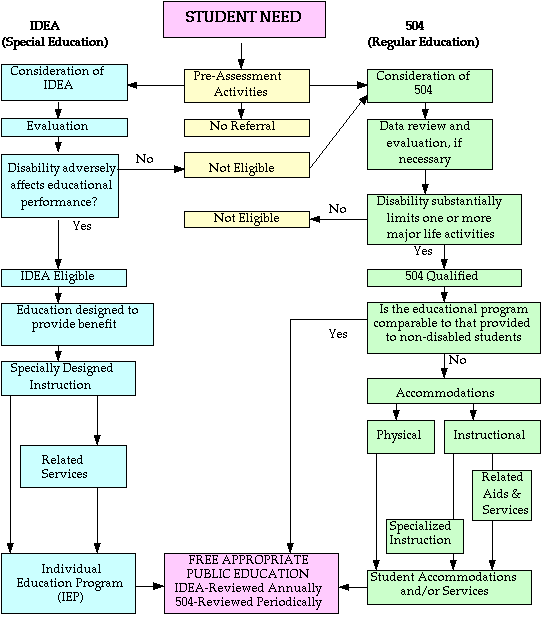
What are the difference between and IEP and a 504? Do general education interventions include modifications? How does this all include FAPE and IDEA? What does FAPE and IDEA mean for my child? There are lots of questions when you start discussing interventions for you child in school. Here are some of the answers.
image via: http://www.aspergerssociety.org/articles/72-Aspergers-and-Autistic-ChildrenHow-Does-a-504-Plan-Differ-From-an-IEP.htm

We should cover some definitions to understand the differences between plans so you can get the best education for your child.
IEP: Individual Education Plan; it outlines special education goals and services for your child as well as providers for those services.
Section 504 - This a section of a civil rights law, The Rehabilitation Act of 1973 that insures equal access to education, the disabilities can include physical and neurological disabilities. For examples of what kinds of disabilities are covered by IDEA and Section 504 refer to this link:http://www.ldinfo.com/idea504.htm
This is not the same as an IEP and the school doesn't get reimbursed for any measures outlined in the 504 plan.
IDEA is Individuals with Disabilities Education Act. It includes what must be in a child's IEP.
FAPE is Free Appropriate Public Education, and again is a part of  IDEA's disability law.

The simplest explanation I have found defining the differences between an IEP and a 504 plan is the following from the University of Kansas Medical Center website:
"A 504 plan is a legal document that outlines the accommodations needed by a student with a disability in order to have equal access to education. An IEP is an individualized, legal document that describes necessary accommodations, modifications and services for students with disabilities. IEPs provide the most intense and comprehensive support because schools receive additional funding to implement them. No funding is provided for general education interventions and 504 plans." - from: http://www.kumc.edu/cchd/fs_schoolsupports.html

image via:http://www.ldinfo.com/idea504.htm
The above handy flow chart is to help guide you through the process of getting your child's needs met in school. If given the option between your child having an IEP and a 504 plan, choose an IEP. A child with an IEP is covered by section 504 of the disability law. Know that your child has the right to a free and appropriate education under the law no matter what kind of accommodation or modification is needed.

Resources:
http://www.wrightslaw.com/blog/IEPand504
http://schoollawpro.com/freestuff/
http://www.wrightslaw.com/info/fape
http://www.wrightslaw.com/advoc/articles/504_IDEA_Rosenfeld.html


Thursday, February 16, 2012

Magic words


image from:http://www.fengshui-doctrine.com/pics/words.jpg
  
 I have some magic words to share with you: Proven Framework for Mainstreaming.
That is the phrase I used in my emails and when talking with administrators while we were choosing a placement for SensiGirl's kindergarten.  I knew from her last IEP meeting that they only thought she could handle up to a maximum of 20% of her day in a regular education classroom, (if that.)  I knew it was important for her to go to a school that knew how to make the transition from a special education classroom to a regular education/inclusion classroom sometime in the future when she was ready.
The words came to me and I knew I had the concept I was trying to articulate when I was feeling dismayed at the other school choices I had.


image from:http://davidmacdonaldmusic.com/wp-content/uploads/2011/07/magneticpoetry.jpg
Sometimes you can research the words into concepts, sometimes you have to sit with them and put them together yourself. The important thing is you find a way to convey what you want for your child.  When talking about extended school year be sure to mention regression and recoupment in the Fall, as well as "window of of opportunity" for educating your special needs child.

When discussing behavior issues involving your child with sensory processing disorder make sure to mention that what looks like bad behavior could be due to involuntary reactions to sensory overload.

When talking about classrooms or school, use the word appropriate, as in free appropriate public education (FAPE,) and a certain class room setting that is appropriate for a child with your child's disabilities.

It is helpful to be familiar with the terms already in use to be able to use them for your child's benefit.  Here is a handy glossary of the terms used in discussing special education.
http://www.disabilityrights.org/glossary.htm

Here is a link to Pennsylvania's Department of Education's pamphlet for understanding the language of special education. It has helpful sections on disabilities and behaviors, and educational terms.
Understanding the Language of Special Education: A Glossary for Parents and Educators

It can be tricky when you see or know of something you don't want for your child. You must find a way to frame or express what you DO want for your child. Many schools have policies about not reqesting a specific teacher by name for your child. I always make sure I express in Random Guy's IEP what kind of classroom and teaching style is helpful for him to make progress.
Use the magic words and you may find you get exactly what you want.


image from:http://img2.etsystatic.com/il_fullxfull.271509594.jpg

Tuesday, February 7, 2012

That's What Happens...


When we started reading the diagnoses books, answering the quizzes and using the assessment tools it became apparent that not only were our children on the autism spectrum, but we were too. My husband, the Atomic Punk, is very musical, is an electrical engineer and has engineering in both sides of his family: his mother and his paternal grandfather. I am adopted, but my developmental history is dotted with quirkiness, to say the least.  I have sensory issues; I rocked all the way from infancy to about 5 years old. I read early, drew a lot and as my dad said, was a wealth of useless information. The only difference between then and now is there is the DSM-IV diagnostic manual to tell us what are the names for these differences.
When you put Savvy Advocate genes with the Atomic Punk's multi-generational engineering genes, you get atypical kids. Neurodiversity is the term for it now. I find that comforting somehow. Here is the introduction to the book by that name: We are not surprised by the fact that we have two children on the spectrum.


Each school year I share the introduction to Neurodiversity by Thomas Armstrong with my children's teachers.  It's my follow up to the Getting to Know Random Guy and Getting to Know SensiGirl letters that I send before the school year begins. 
The Introduction/Getting to Know letters are a one page brief of all the little quirks that you won't find listed in the IEP. A small thing like Random Guy is more comfortable when he can see the daily schedule. He likes to know what is coming up; it makes the transitions from class to class easier. Big things like SensiGirl is terrified of Veggie Tales, the mere mention of it will turn her into a screaming noodle on the floor. SensiGirl's Kindergarten teacher also said it was really helpful to know the statement “...or a mustache," really meant not liking ANY of the choices SensiGirl is given at that moment.
 I list all the therapies she is doing and how they effect her. I try to include the things that may have surprised last year's teacher. Basically the Getting to Know letter will include: abilities and deficits, fears, therapies and effects, medical issues and motivators. Be sure to include the best way to reach you and an invitation to contact you. 
Really there is nothing better than to meet and communicate with the kids' teachers on a regular basis.  It is always good to relate to them the traits you and your spouse share with your child. It gives the teachers perspective; even though the kids are quirky now, that doesn't mean they can't be successful in school or as adult. The quirks don't matter as much after you grow up and find your path in life.  In fact that path might lead you to someone who is a whole lot like you.

Thursday, February 2, 2012

It's a Start

photo from: http://taxdollars.ocregister.com/files/2011/03/Path2.jpg
Special education, advocacy and support are what this blog is about.  Being a mom with a girl with an ASD diagnosis  has changed things for me. I have found that being a mom of a child in special education is sometimes lonely.
You may have the love and support of your family and friends, but very few of us really know  from the start what to do to get what your child needs from school and the community.
 The moment of diagnosis changes your path in parenting.  You are now on a different track from your friends and neighbors and will have to find a way to navigate an unfamiliar path through to your child's adulthood. I am not there yet. My daughter just started kindergarten this year. I also have a son who has an IEP for ASD. He is mainstreamed in a 4th grade class now.
I have some experience, but I do not know it all. This is a place where we can share information and support each other. I will be posting various links and information that I have found helpful. My next post will most likely be about iPad apps that have worked for us. I will also post about IEPs, transitions, and what therapies we have had experience with so far.