 |
| photo by LEGGustafson |
Showing posts with label IDEA. Show all posts
Showing posts with label IDEA. Show all posts
Tuesday, February 5, 2013

Wednesday, May 30, 2012
It's the Law: IEPs, IDEA, Section 504 and Interventions
 |
| image via:http://www.asylum.com/2009/06/08/hangovers-what-causes-them-and-what-cures-them/ |
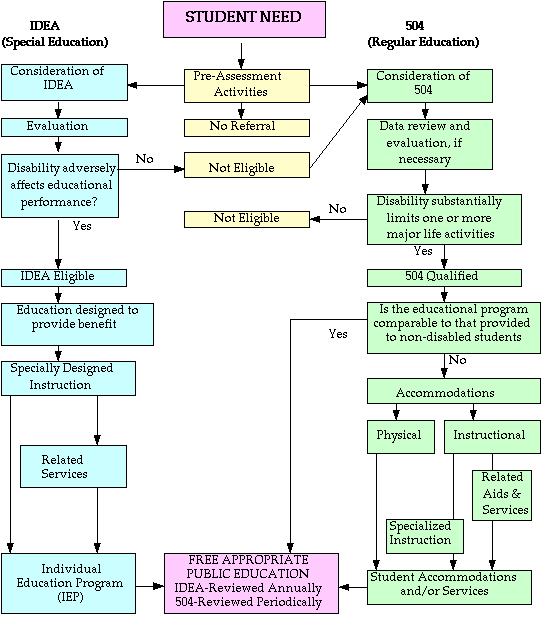
What are the difference between and IEP and a 504? Do general education interventions include modifications? How does this all include FAPE and IDEA? What does FAPE and IDEA mean for my child? There are lots of questions when you start discussing interventions for you child in school. Here are some of the answers.
 |
| image via: http://www.aspergerssociety.org/articles/72-Aspergers-and-Autistic-ChildrenHow-Does-a-504-Plan-Differ-From-an-IEP.htm |
We should cover some definitions to understand the differences between plans so you can get the best education for your child.
IEP: Individual Education Plan; it outlines special education goals and services for your child as well as providers for those services.
Section 504 - This a section of a civil rights law, The Rehabilitation Act of 1973 that insures equal access to education, the disabilities can include physical and neurological disabilities. For examples of what kinds of disabilities are covered by IDEA and Section 504 refer to this link:http://www.ldinfo.com/idea504.htm
This is not the same as an IEP and the school doesn't get reimbursed for any measures outlined in the 504 plan.
IDEA is Individuals with Disabilities Education Act. It includes what must be in a child's IEP.
FAPE is Free Appropriate Public Education, and again is a part of IDEA's disability law.
The simplest explanation I have found defining the differences between an IEP and a 504 plan is the following from the University of Kansas Medical Center website:
"A 504 plan is a legal document that outlines the accommodations needed by a student with a disability in order to have equal access to education. An IEP is an individualized, legal document that describes necessary accommodations, modifications and services for students with disabilities. IEPs provide the most intense and comprehensive support because schools receive additional funding to implement them. No funding is provided for general education interventions and 504 plans." - from: http://www.kumc.edu/cchd/fs_schoolsupports.html
 |
| image via:http://www.ldinfo.com/idea504.htm |
Resources:
http://www.wrightslaw.com/blog/IEPand504
http://schoollawpro.com/freestuff/
http://www.wrightslaw.com/info/fape
http://www.wrightslaw.com/advoc/articles/504_IDEA_Rosenfeld.html
Wednesday, February 8, 2012
Buzzwords, acronyms and other jargon
 |
| image from :http://60secondmarketer.com/blog/wp-content/uploads/2011/11/BuzzWord.jpg |
Teachers sometimes speak their own language. We call it Eduspeak in our house. I am guilty of using myself. It is sometimes used thoughtlessly as shorthand, shorthand for thoughtlessness or sometimes to intimidate parents into going along with the plan at hand. Below I provide the link to acronyms.com, some of the eduspeak doesn't come up at the top of the list, but its educational meaning is there in the list, just look for it. In testing it I tried the following:
ESY
SLP
IEP
IDEA
RTI
Try them yourself: http://www.all-acronyms.com/
(For those in a time crunch the above are ESY -Extended School Year, SLP - Speech Language Pathologist, IEP - Individual Education Plan, IDEA - Individuals with Disabilities Education Act, RTI - Response to Intervention.
There is an extra dialect spoken at meetings by special education teachers, occupational and speech therapists and school administrators. Here are some humorous but handy links of what some of the buzzwords in special education mean:
http://www.illinoisloop.org/buzzwords.html
http://kidfriendlyschools.blogspot.com/2012/01/guide-to-eduspeak.html
You may want to try it yourself, just for fun.
Eduspeak Generator
Humor aside, what you need to do when talking with educators, is to not feel intimidated by the jargon and acronyms. Check your copy of the IEP for anything unfamiliar when it is handed out at the meeting. Speak up and ask them what is meant or to use different words. Ask for straightforward language or just plainly ask what XYZ means. Knowing acronyms and buzzwords is not a measure of intelligence. You can ask to take the IEP home and to read it again before you sign. You do not have to sign a document full of acronyms and jargon you don't understand.
If you don't know - ask! If nothing else, it will make everyone take a moment in the conversation to help you grasp what they are saying about your child and how you can to plan for success together.
 |
| image from: http://www.zazzle.com/iep_t_shirt_tshirt-235467725162104343 |
Subscribe to:
Posts (Atom)