Showing posts with label special education. Show all posts

Wednesday, September 17, 2014

Special Education Parent Skill Set

image via: http://www.glasbergen.com/wp-content/gallery/creative/thumbs/thumbs_cre23.gif

Sitting in the waiting room at one of my kids' therapy appointments, I met a mom who is just starting her special education journey. Our conversation made me realize that being a special education parent you evolve a certain skill set. With practice you get good at some things that may not come naturally to you and are not taught. Most of us learn this by trial and error.


image via: http://studyhungary.dev.xtremedia.hu/upload/images/comm.jpg

Communication - Once you are a special needs parent it is important to communicate what your child needs and to advocate for them. You are going to have to communicate with lots of different professionals. Make sure you understand what they are telling you and ask lots of questions. Also make sure they understand what you are telling them. I send a getting to know you letter to my children's educators every year. This year I also discovered it was helpful to share that information with the transportation staff too.


image via: http://www.theopennotebook.com/wp-content/uploads/2011/10/ask-215x300.jpg

Ask for what you need - If your child needs something, the sad truth is you are going to have to ask for it. There may be offers for help here and there but if your child or family needs something from a school district, or the local government you most certainly have to ask. The honest truth is that's how they keep their costs down. They sometimes can't help you UNTIL you ask, so ask.


image via: http://tweakyourbiz.com/management/files/shutterstock_187332701.jpg

Hold the professionals accountable- If you don't understand what is going on with your child at school ask for some explanation. Once your child is labeled and designated special needs you get either an IEP or a 504. As a parent of a child with an IEP you can call a meeting to discuss their services at any time of year. If the school district withholds information or services, remind them of your rights. Wrightslaw.com is a great resource for what you can legally advocate for and what you should expect from the professionals serving your child.


Persistence -  Sometimes you will have to ask more than once, or someone will have a bad attitude when you deal with them, and you need to devise a work around. You will have to continue to advocate for your child even in the face of an adversarial attitude and ignorance. Keep trying and keep looking for a solution or resolution. Resources are limited and sometimes they count on you giving up. Don't give up.



Problem solving- I have been a noodler since I was a kid, so problems solving and puzzling out solutions is a natural state for me. Sometimes the problems are bigger than your abilities or experience. Look for solutions in other places if you are not getting what you need from your local school district. Ask for help from local advocacy agencies like your local autism society or your local version of PACER.  I home schooled my son with K-12.com last year when his transition to middle school failed. I also pulled my daughter from the school district when they targeted her autism program for elimination. Even though her school placement last year was far from ideal, it positioned us to be one of the first families to attend the new autism school in the special education district that serves the northern suburbs of our area.


image via: http://media-cache-ak0.pinimg.com/736x/89/ec/eb/89eceb77fa0f69aa49fa8aa4775a09e2.jpg

Pick your battles/Know when to cut your losses-If the school district has decided that all special education students belong in the general student population no matter what their needs, there isn't much you can do about it besides a lawsuit. That takes time, (which you don't have since your child's development is at stake,) and money. You may be able to win a legal battle, but sometimes its just best to look for your solution somewhere else. I am not saying not to go through the steps of advocacy. Talk to your school board, the special education department, even your local newspaper. But sometimes you cannot change the tide and you need to devote your energies elsewhere.


image via: http://lisbethcalandrino.com/wp-content/uploads/2012/10/networking1.jpg

Networking - Look for other parents either online or in your school district. Having a special needs child can be isolating. There usually aren't enough of us concentrated into our neighborhoods and with enough free time to form a local support group. You may be lucky and get someone from the school district to host a monthly support meeting. You should look to see if there is a special education advisory council in your school district and join. This is where you will get the information of what the school district plans are for special education in the coming months or years.
The online special needs community is there for you 24/7 or at least as often as some of us can get to a computer. There are Facebook pages and groups, as well as lots of blogs to follow (Snagglebox has been one of my favorites.) You may be overwhelmed by all the information available about your child's diagnosis at first, but with time you will find your trusted information sources. The Thinking Person's Guide to Autism, Autism with a side of Fries,  and Shut Up About Your Perfect Kid are some examples of my favorite special needs communities online.

Wednesday, May 30, 2012

It's the Law: IEPs, IDEA, Section 504 and Interventions

image via:http://www.asylum.com/2009/06/08/hangovers-what-causes-them-and-what-cures-them/

What are the difference between and IEP and a 504? Do general education interventions include modifications? How does this all include FAPE and IDEA? What does FAPE and IDEA mean for my child? There are lots of questions when you start discussing interventions for you child in school. Here are some of the answers.
image via: http://www.aspergerssociety.org/articles/72-Aspergers-and-Autistic-ChildrenHow-Does-a-504-Plan-Differ-From-an-IEP.htm

We should cover some definitions to understand the differences between plans so you can get the best education for your child.
IEP: Individual Education Plan; it outlines special education goals and services for your child as well as providers for those services.
Section 504 - This a section of a civil rights law, The Rehabilitation Act of 1973 that insures equal access to education, the disabilities can include physical and neurological disabilities. For examples of what kinds of disabilities are covered by IDEA and Section 504 refer to this link:http://www.ldinfo.com/idea504.htm
This is not the same as an IEP and the school doesn't get reimbursed for any measures outlined in the 504 plan.
IDEA is Individuals with Disabilities Education Act. It includes what must be in a child's IEP.
FAPE is Free Appropriate Public Education, and again is a part of  IDEA's disability law.

The simplest explanation I have found defining the differences between an IEP and a 504 plan is the following from the University of Kansas Medical Center website:
"A 504 plan is a legal document that outlines the accommodations needed by a student with a disability in order to have equal access to education. An IEP is an individualized, legal document that describes necessary accommodations, modifications and services for students with disabilities. IEPs provide the most intense and comprehensive support because schools receive additional funding to implement them. No funding is provided for general education interventions and 504 plans." - from: http://www.kumc.edu/cchd/fs_schoolsupports.html

image via:http://www.ldinfo.com/idea504.htm
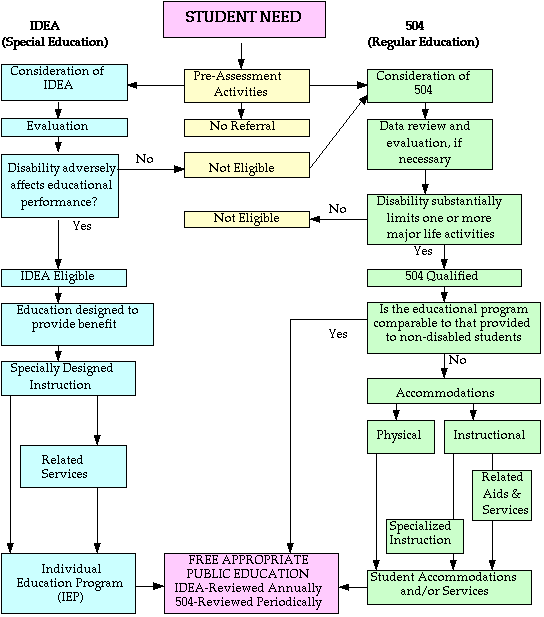
The above handy flow chart is to help guide you through the process of getting your child's needs met in school. If given the option between your child having an IEP and a 504 plan, choose an IEP. A child with an IEP is covered by section 504 of the disability law. Know that your child has the right to a free and appropriate education under the law no matter what kind of accommodation or modification is needed.

Resources:
http://www.wrightslaw.com/blog/IEPand504
http://schoollawpro.com/freestuff/
http://www.wrightslaw.com/info/fape
http://www.wrightslaw.com/advoc/articles/504_IDEA_Rosenfeld.html


Friday, May 25, 2012

Co-teaching and Inclusion


image via: http://www.vcld.org/pages/newsletters/03_04_fall/teacher.htm

This last week at the Special Education Advisory Committee we talked about the new plan to have more special education resources in our neighborhoods. This means they may want to move SensiGirl from the school she is successful in to one that isn't equipped to deal with her needs.
The plan is to expand services in each busing zone so they don't have to bus children across town to school. This makes sense when it is a language immersion school or an arts school, not when it is a special needs program. Their solution to the lack of appropriate placements in each busing zone is to expand the special education programs in each zone. This is a commendable goal, as most parents don't want to put their child on a bus for 45 minutes or more, or drive them every day to get to a school across town. I know that busing is a large expense for the school district and they need to cut costs.
I would encourage them to slow down a bit.  The teachers who are going to be providing the services in each zone need special training. It has to be more than adding additional teachers and putting a new label on a program and saying it is appropriate for all special education students in that area. If done right, it could attract more kids into the district, as there would be more classrooms available to special education students.
I asked some questions as to how they propose to provide the kind of education and services that I found in SensiGirl's school in the neighborhood zone special education school. The answer was to expand services to include co-teaching and inclusion.
image via: http://www.unco.edu/ncssd/Presentations/jackson/pbs/ui/slidepic1.gif

Co-teaching is when a special education teacher and a general education teacher team up to teach a class together. They share responsibility of running the classroom. They put the lesson plans together as a team, with the needs of the special education kids in mind. This is the preferred method of inclusion being practiced right now. Inclusion is thought to be the replacement for mainstreaming. The problem is what about he kids who can't handle being in a room with 20 other kids? That needs to be addressed before immersing a student into a general education classroom for the whole day. Mainstreaming has its place, we should think of classrooms meeting the needs of special ed. students like the spectrum we think of for autism. The reality is that there isn't a one size fits all solution to the need for expanded services.
There is more to co-teaching than just additional teachers in the room to get a successful program like SensiGirl's into the neighborhood school. They need to take the time to pair up and train the teachers to get good co-teaching relationships.
The problem is that inclusion with co-teaching is the ideal. The real world application is most likely co-instructing or co-working, with the worst outcome being co-existing. The benefit of co-teaching would be to expose children with special needs and children in the general education classroom to each other.  The cost might be to the expense of the special needs child's education. I hope they make the effort to get it right. It would be a great boon to our school district if they can make it work well.
This is an expansive topic, I am sure there will be more to share about inclusion and co-teaching. Let me know if you have had any experiences with this in your school and how it worked. What are the pitfalls? Let's talk about them, so we can reduce the learning curve for all of us.  Let's make sure we advocate to make it right for our kids.

image via: http://www.carlisle.k12.ma.us/Assets/KWelcome.jpg
The ideal classroom

Monday, April 30, 2012

Federal Classroom Settings, Transitions and Mainstreaming

image via: http://loddymicucci.com/faith-transcends-your-limiting-beliefs/
My SensiGirl is in a Federal Setting 3 classroom. When that placement was brought up at her IEP last year, it made me cry. I felt like it was hopeless for her to get into a regular education classroom eventually. I felt like she was being restricted into a special education box and she wouldn't be able to get out. I had to do some more looking to find out more about what it really meant. This chart spells it out clearly what that means.

Federal Instructional Settings
School Age Students 6 through 21
01  Regular Class - less than 21% in special education classroom/setting
02  Resource or Self-Contained - 21-60% in special education classroom/setting
03  Separate Class - more than 60% in special education classroom/setting
04  Public Separate Day School Facility - more than 50% of day
05  Private Separate Day Facility - more than 50% of day at public expense
06  Public Residential Facility - more than 50% of day
07  Private Residential Facility - more than 50% of day at public expense
08  Hospital or Homebound Placement
Follow the link below for the full complement of settings including for children birth to 5:
http://specialed.spps.org/uploads/federal_instructional_settings.pdf

Federal settings have to do with how much time is spent in the regular education classroom, not the quality of instruction or if that setting is best for your child. You have to look beyond the label of "Federal Instruction Setting" to understand what it means for your child.

image via: http://www.thecrankymonkey.com/2010_02_01_archive.html

 It was explained to me that SensiGirl needed a special classroom to get her started out right in grade school. Simply put: if she became overwhelmed with the regular education classroom with 20 kids and all the noise and motion going on, she might not make the transition into elementary school without being traumatized. SensiGirl being like she is with a memory like a steel trap, if things went wrong, we might not get another chance to get it right. A separate classroom with only 10 other students and extra teachers as well as easy access to speech and occupational therapy specialists was what was in order for SensiGirl to get a good start in elementary school. She made the transition to her new school with the minimum possible upset for her, and she is now spending time mainstreamed in the regular ed. classroom during writer's workshop.
This is not to say that we got her in a regular education classroom with no hiccups. We were not very successful in our first attempt to introduce a regular ed. classroom to her. Breakfast and morning meeting was not her thing. She didn't like the transitioning within the classroom and didn't like crowding around the teacher with the other kids on the floor. The teacher tried to make it work, even having SensiGirl sit on her lap, but it didn't work. We had to find things she really liked, which were writing and drawing and introduce her to the classroom doing those things.

From Friends A Primer, (Pennell and Cusack, 1930’s)
image via:http://fithfath.com/images/?tag=classroom

We talked at her IEP last week about how to extend her time in the regular education classroom next year.  The transition into elementary school is a tough one for most special needs kids, making the transition as smooth as possible for them is the key, and then once they are used to their environment, you can start to test the possibilities of expanding their time in other settings.

resources:
http://specialed.spps.org/uploads/federal_instructional_settings.pdf

Monday, March 12, 2012

What I Learned From Our Tutor


image via: http://specialneedseducationoer.files.wordpress.com/2011/04/special-education-teacher1.jpg

We have learned a lot from our Family Friend Grad Student. I am grateful every time she comes over to work with SensiGirl. She has been an eye opener to me about the current state of teacher education. She was told that she was wasting her time getting two degrees by her advisor. She is getting a degree in Early Childhood Education and one in Special Education. When she visits different educational settings, she is told a different story that makes her believe she is on the right track. She watched a boy come in the other day to Montessori school. She saw how he behaved and asked some questions about how he socializes and started to figure out that the boy might need some extra help. She wouldn't know what that boy needed help with or how to help if she hadn't been training in special education along with her early childhood training.
When I introduce and teach Random Guy's teachers about him each year I wish for one with some experience with autism or at the very least IEP's and special education.  It doesn't happen very often. Either it is the teachers weren't taught or they don't want to learn about special education and what kinds of things they can do to help Random Guy in class.

image from:http://blogs.edweek.org/teachers/coach_gs_teaching_tips/Teacher%20Homework.jpg

I wish all general education teachers received some training in special education, mainstreaming and inclusion I know that teachers have to have continuing education credits to maintain their certification, my question is what are they doing to earn those credits? I am not seeing much in the way of understanding how to teach my child. When I looked at the professional development websites for credits for license renewal I saw very few containing topics that apply towards special education, even though most classrooms contain at least a few students with an IEP or a 504. In a quick check online at the offerings to certification credits in my area, only 10% are offered in the area of inclusion and teaching children with differing abilities. This is not to say that there is no progress in this area, it's just that I am failing to see as much progress as I would like.  I see a young teacher raring to go to work with children like mine and I am sad to see her discouraged by her advisers.  I am glad she is going to be a teacher, the kids need someone like her.
image via: http://rlv.zcache.com/blackboard_worlds_greatest_earlychildhood_
teacher_tshirt-p235200607739734517zv365_400.jpg


resources: http://www.kdsi.org/Minnesota-ECSU.aspx

Thursday, February 16, 2012

Magic words


image from:http://www.fengshui-doctrine.com/pics/words.jpg
  
 I have some magic words to share with you: Proven Framework for Mainstreaming.
That is the phrase I used in my emails and when talking with administrators while we were choosing a placement for SensiGirl's kindergarten.  I knew from her last IEP meeting that they only thought she could handle up to a maximum of 20% of her day in a regular education classroom, (if that.)  I knew it was important for her to go to a school that knew how to make the transition from a special education classroom to a regular education/inclusion classroom sometime in the future when she was ready.
The words came to me and I knew I had the concept I was trying to articulate when I was feeling dismayed at the other school choices I had.


image from:http://davidmacdonaldmusic.com/wp-content/uploads/2011/07/magneticpoetry.jpg
Sometimes you can research the words into concepts, sometimes you have to sit with them and put them together yourself. The important thing is you find a way to convey what you want for your child.  When talking about extended school year be sure to mention regression and recoupment in the Fall, as well as "window of of opportunity" for educating your special needs child.

When discussing behavior issues involving your child with sensory processing disorder make sure to mention that what looks like bad behavior could be due to involuntary reactions to sensory overload.

When talking about classrooms or school, use the word appropriate, as in free appropriate public education (FAPE,) and a certain class room setting that is appropriate for a child with your child's disabilities.

It is helpful to be familiar with the terms already in use to be able to use them for your child's benefit.  Here is a handy glossary of the terms used in discussing special education.
http://www.disabilityrights.org/glossary.htm

Here is a link to Pennsylvania's Department of Education's pamphlet for understanding the language of special education. It has helpful sections on disabilities and behaviors, and educational terms.
Understanding the Language of Special Education: A Glossary for Parents and Educators

It can be tricky when you see or know of something you don't want for your child. You must find a way to frame or express what you DO want for your child. Many schools have policies about not reqesting a specific teacher by name for your child. I always make sure I express in Random Guy's IEP what kind of classroom and teaching style is helpful for him to make progress.
Use the magic words and you may find you get exactly what you want.


image from:http://img2.etsystatic.com/il_fullxfull.271509594.jpg

Wednesday, February 8, 2012

Buzzwords, acronyms and other jargon


image from :http://60secondmarketer.com/blog/wp-content/uploads/2011/11/BuzzWord.jpg

Teachers sometimes speak their own language. We call it Eduspeak in our house. I am guilty of using myself.   It is sometimes used thoughtlessly as shorthand, shorthand for thoughtlessness or sometimes to intimidate parents into going along with the plan at hand. Below I provide the link to acronyms.com, some of the eduspeak doesn't come up at the top of the list, but its educational meaning is there in the list, just look for it. In testing it I tried the following:

ESY
SLP
IEP
IDEA
RTI

Try them yourself:  http://www.all-acronyms.com/

(For those in a time crunch the above are ESY -Extended School Year, SLP - Speech Language Pathologist, IEP - Individual Education Plan, IDEA - Individuals with Disabilities Education Act, RTI - Response to Intervention.

There is an extra dialect spoken at meetings by special education teachers, occupational and speech therapists and school administrators. Here are some humorous but handy links of what some of the buzzwords in special education mean:

http://www.illinoisloop.org/buzzwords.html

http://kidfriendlyschools.blogspot.com/2012/01/guide-to-eduspeak.html

You may want to try it yourself, just for fun.
Eduspeak Generator


Humor aside, what you need to do when talking with educators, is to not feel intimidated by the jargon and acronyms. Check your copy of the IEP for anything unfamiliar when it is handed out at the meeting. Speak up and ask them what is meant or to use different words. Ask for straightforward language or just plainly ask what XYZ means. Knowing acronyms and buzzwords is not a measure of intelligence. You can ask to take the IEP home and to read it again before you sign. You do not have to sign a document full of acronyms and jargon you don't understand.
If you don't know - ask!  If nothing else, it will make everyone take a moment in the conversation to help you grasp what they are saying about your child and how you can to plan for success together.


image from: http://www.zazzle.com/iep_t_shirt_tshirt-235467725162104343


Monday, February 6, 2012

She's So Sensitive


SensiGirl was born sensitive. She is a screamer, the kind of scream that vibrates your eardrums. I've been told she has the scream of a grown woman.  She really started screaming when I left her with the teachers in ECFE,(Early Childhood Family Educacion.) The other kids really didn't seem to mind when the mommies went to have a little coffee and sit down talk about child development. They would cry a little and then notice some cool toy or have a snack and they were over it. SensiGirl did mind. She minded so much that we had to work for months to get a chance for me to spend some time with Random Guy in the bigger kid classroom or to participate in parent group for a few minutes.
The screaming was one of the reasons they thought a special ed. preschool classroom was warranted. There was testing when she was 18 months old and every few months thereafter. She wasn't keeping up with the other kids in speech acquisition. She was too sensitive to her environment, she was too sensitive to everything.

When I saw this study at the Autism Speaks website it made sense to me.
http://www.autismspeaks.org/science/science-news/autism-risk-gene-linked-sensory-overload

We tried some different kinds of therapies but the one I think that has really helped her get over some of her reluctance to join us in our world was listening therapy. She was either checked out and spacey or she was screaming because something was too bright, too loud, too much.
When we started TherapeuticListening last year, I was hopeful, but didn't really know what to expect. Since we started Occupational Therapy and Speech Therapy all at once, (due to insurance changes,)  it is impossible to tell which one is having the most therapeutic effect, but I know she doesn't scream at family gatherings any more and she can now go into a gymnasium and not lose it.
This therapy is done in concert with other therapies recommended by her Occupational Therapist, so I warn you not to do this without professional input as some of the tracks can have unexpected or upsetting effects. They are trained specifically in how to do this therapy and it shouldn't be done on you own to just try it and see.

http://www.vitalsounds.com/CustServ.aspx

photo from: http://www.aitinstitute.org/AUDITORY_INTEGRATION_TRAINING/boy_white2.jpg


She is learning coping strategies that help her deal with uncomfortable situations. Last Thanksgiving instead of leaving early because she had been crying for a hour, she spent the first half hour at Grandma's house with her fingers in her ears. She chose to stay in a quiet part of the house and after a few hours told me she was ready to go home. That hadn't happened before. She can tell us things now, she has figured out sometimes life is too loud and how to do something about it.  I am thankful that she is making progress.


Thursday, February 2, 2012

It's a Start

photo from: http://taxdollars.ocregister.com/files/2011/03/Path2.jpg
Special education, advocacy and support are what this blog is about.  Being a mom with a girl with an ASD diagnosis  has changed things for me. I have found that being a mom of a child in special education is sometimes lonely.
You may have the love and support of your family and friends, but very few of us really know  from the start what to do to get what your child needs from school and the community.
 The moment of diagnosis changes your path in parenting.  You are now on a different track from your friends and neighbors and will have to find a way to navigate an unfamiliar path through to your child's adulthood. I am not there yet. My daughter just started kindergarten this year. I also have a son who has an IEP for ASD. He is mainstreamed in a 4th grade class now.
I have some experience, but I do not know it all. This is a place where we can share information and support each other. I will be posting various links and information that I have found helpful. My next post will most likely be about iPad apps that have worked for us. I will also post about IEPs, transitions, and what therapies we have had experience with so far.