Showing posts with label IEP. Show all posts

Monday, October 8, 2012

Writing an Effective E-mail to School

As much as you would like to, do not send this:


image via: http://harrypotter.wikia.com/wiki/File:Howler.JPG


There comes a time when you are going to have to communicate your concern or displeasure to the school. There are a few things you will want to cover in your missive. 
I have had to write several and will share with you some examples to show you what to try to achieve.

MPR photo/Tom Weber    image via: http://minnesota.publicradio.org/display/web/2012/09/04/education/school-bus-delay/

Dear Ms. M and Mr. A,
I am writing to articulate my preferences for Sensi's placement for Kindergarten. I understand the district wants to keep children in their transportation area for school placement. My concern is that decision is made by transportation considerations alone. I am very willing to transport Sensi to her school rather than leave the school placement decision to transportation concerns.
Sensi has to be placed in a program that has mainstreaming as part of its framework. Her IEP states that she will be mainstreamed for at least an hour of each school day, and up to 2 and a half hours, with the understanding that when she is ready for more mainstream classroom time we will call an IEP meeting.  I want to make sure that is a positive experience for her so we don't see any regression in her skills. To do that she needs to attend a school that has a proven plan for mainstreaming children with autism. The Autism Program has shown me that they have that plan.
My next concern is about technology. I feel as if the program at Neighborhood Elementary was less than enthusiastic about using Sensi's iPad with her in class. In comparison, the positive feedback I got from the teacher at the Autism Program was that using the Proloquo2Go program would not be a problem.
I hope that my articulating my concerns and needs for Sensi will help  you make the best decision for Sensi's Kindergarten experience.
Sincerely,
Savvy Advocate Mom 

image via: http://alexgiampapa.wordpress.com/2012/08/01/fire-drills-why-bother/

Dear Mr. B and Ms. J,
It has come to my attention that you did not warn The Autism Program that there would be a fire drill last Thursday, Oct. 4, 2012. I want you to know that it is very detrimental to The Autism Program students not to give them advance warning of these drills. My child in particular has had AIT (Auditory Integration Training,) therapy this last summer. She needs to have her hearing protected after having this expensive, intensive listening training. She is supposed to have her hearing protected from extremely loud sounds for the next year. She is not allowed to attend movies in theaters, wear music ear buds or music headphones. I have alerted her IEP team to this situation, but they cannot be expected to protect her hearing without any warning of alarms. They have noise dampening earphones in the classroom to protect the children's ears, but they must know ahead of time to put them on the children before an alarm to have the protective effect.
I am asking you to please alert The Autism Program, and Ms. W.T. in particular about any planned fire drills, tornado drills or other alarms that will be scheduled during this school year to protect my daughter's hearing and progress she has made from doing AIT therapy.

Sincerely,
Savvy Advocate Mom
Parent/Advocate

image via: http://www.californiademocrat.com/news/2011/oct/11/spaghetti-dinner-fundraiser-russellvillelohman-fir/

Honestly, I think I did a better job in the first letter, because I gave myself more time to think and plan. The second one only took me about an hour from start to my second draft. The first one I think I may have done at least three drafts.
It is important to state clearly what your concern is, what you want done and how you think that can be accomplished. Be sure to state what you are willing to do as well as any other outstanding circumstances that effect the situation.  It is a good idea to include dates and other specifics as well. Make sure not to blame any one person for a short coming if that is not the case. Even though I felt that the teacher at my neighborhood special ed program was lacking, I did not lead with that, rather I used it a almost an afterthought. The bigger issue of mainstreaming, which was a programming/structural problem that needed to be addressed. State how your wishes are supported by the IEP or 504 plan you have for your child. Make sure they know how to contact you and also know who is the next person up the chain to contact if you are not satisfied with the result from you communication. You must to follow up later if you don't hear from the addressee in a timely manner. The follow up letter can be addressed to the original addressee and their superior.
image via:http://www.autmont.com/2012/09/wrightslaw-conference-in-silver-spring.html

For more information on writing an effective letter, including taking time to cool off, and making your first try a DRAFT, follow this link:
 http://www.wrightslaw.com/advoc/articles/12rules_letters.htm


Monday, September 24, 2012

Pick Your Battles: Everyday Math

image via:  http://www.comicvine.com/myvine/cloverfield/all-images/108-400509/calvin_hobbes/105-1452730/ 
I have been fighting an ongoing battle with the school district over their insistence that Random Guy be taught Everyday Math at school. We have tried tutoring him at home with Singapore Math and Core Curriculum Math. He does better for a while and then starts falling behind as the exposure to Everyday Math increases. His confidence in his abilities plummets when it comes time to divide the class into different groups to teach math each year. He may not be as social adept as some kids but he know what the "s/low" group is and knows what it means.

image via:  https://www.facebook.com/pages/Parents-Against-Everyday-Math/37453309495?v=wall&viewas=0 

I had a meeting with his teacher, the school social worker and the learning specialist at his school today to come to an agreement about how to teach Random Guy math this year. I went with his most recent IEPs and his previous report cards in my green expanding folder.
I went in asking for him to be pulled out during math and a separate math curriculum. I explained that I had to reteach everything taught in class these past few years and that with two children having homework and therapies to go to I just don't have the time or ability to teach my son Everyday Math, every day, without any training. I explained that he is cognitively different than most of the other children and being so, needed mastery of a concept before being asked to move on to another one.

image via:  https://www.facebook.com/pages/Parents-Against-Everyday-Math/37453309495 

I left with a modification for less homework, an agreement that Random Guy would not be shuffled among the teachers and put into a "low" group and that the algorithms taught would be the standard ones not the loopy multiple ways Everyday Math has to solve the same problem. I was told the homework emphasis will be on the traditional algorithms and that the problems to be worked will be marked discretely on his worksheet or booklet, so there is no misunderstanding what work needs to be completed. I was assured that this was going to be the last grade that they will be using Everyday Math. Next year, for middle school there will be a traditional math curriculum.

Wait, what was your strategy?
image via:
http://www.wall321.com/Entertainment/TV_Series/david_tennant_
doctor_who_tv_series_1024x768_wallpaper_26513

Some would say that I didn't get what I was asking for, but really I think I got quite a bit. I got the modification spelled out by the learning specialist to the teacher. I got an agreement not to move my child from teacher to teacher to learn math, but rather stick with one teacher who now knows the modifications. There are 12 units this school year, so I kept Random Guy from having to move between three different teachers, two of which were not there for the meeting, and haven't got a clue about Random Guy.  I also got a chance to see what the reworked test format will be and what the standards are for the grade.
I got a meeting of the minds that Random Guy's teacher was going to follow the program. She also showed me how she is going to track his progress and increase the difficulty level of his work as he improves his performance.
image via:  http://www.specialeducationadvisor.com/top-ten-common-questions-about-special-education/ 

I sent a email (with a copy going to my husband,) thanking them for the meeting and outlining the agreed modifications and requested that the modifications be listed in his IEP.
It is best when faced with difficulties like this to find a way to solve the problem so your child gets the benefit of a modification rather than fight and fight and no movement occurs on their part for an adaptation or accommodation. It is a fine line to walk when advocating  for your child. You risk being viewed as helicopter parent, when really, experience has taught you to be proactive rather than reactive to save yourself and your child a lot of wasted time and energy.  Part of being a special ed. parent is having to teach the teachers every year. Part of being a special ed. parent is also learning from having to teach the teachers every year.

Monday, August 20, 2012

Back to School: Getting to Know You Letters

image via:  http://prek-8.com/holiday/backtoschool/backtoschool_invitation.php 
I have a letter that I edit and adapt for each of my children for their new teachers when they start a new grade. I have talked about it here: that's-what-happens
This year, SensiGirl has the same teacher as last year. WunderTeacher gets it. She is very intrigued by Sensi's various skills and is a pro at handling difficult behaviors. She plans and thinks ahead, so luckily our collaboration on SensiGirl's Getting to Know You letter for ESY makes writing a new one unnecessary. I do need to update her IEP since she participated in AIT therapy this summer and she will need her hearing protected during fire drills and keep listening headphones off for at least 6 months.
We have to make sure to attend the Open House for Random Guy. I send his father, the Atomic Punk, along since I don't do crowds very well and he doesn't seem to mind too much. That way he and the teacher get to meet, since they usually won't see each other again during the school year due to Atomic Punk's work schedule. It's helpful that they meet him so that when I refer to similarities between Random Guy and his father that they have seen the grown up version and can make connections about where things are going in Random's development.
image via:  http://cheezburger.com/2582425088

Random Guy is going to be getting a full update for his letter as there have been quite a few changes for him this last year. He is still having trouble socially and will need some help with navigating the 5th grade social scene. We have cemented most of his basic math facts this summer, but he still has trouble with the spiraling and looping that is Everyday Math. I have more work to do to change his math curriculum in his IEP. Luckily at his school I have allies in both the school social worker and the principal.
image via:  http://www.buzzle.com/articles/getting-to-know-you-activities-for-the-first-week-of-school.html 

The letter goes something like this:

                        Getting to Know Random Guy
I just wanted to share some information about Random Guy with you. He started wearing glasses for nearsightedness this summer. He prefers to be called Randy now rather than Random. R. is a great builder and has a wonderful visual memory.  He is interested in American History, Geography and Social Studies, (he’s really good with dates.) R. does well with spelling and is very proud of learning to cursive write. He loves all kinds of Legos themes, Pokemon and Dr. Who. He is a fan of the Wimpy Kid Books and of the Avengers.
He may not look at you or make eye contact while you are talking, but he is usually listening.  It sometimes is easier for him to concentrate when he isn’t looking directly at the speaker. He doesn’t like those unfamiliar to him to touch him or get in his space. We have found that he does better with getting to class on time if he has a locker or coat hook at the end of the row, otherwise he stands back and waits and waits for the others to finish up.
He has an IEP with the disability label of autism, please read it if you can.  In it there is a testing adaptation, R. is supposed to sit apart from the other children when he takes tests. R. likes to know the daily routine and will most likely memorize it. It helps if it is written somewhere he can refer to at first.  R. doesn’t like to be singled out for discipline in front of the class, he would prefer that you take him aside and talk to him privately or at least quietly.  He also has some trouble with reading facial expressions or understanding when someone is being mean to him right away, and sometimes has trouble with bullies because of that.
He will not report a bullying incident immediately, but will tell me or his father later that day, or the next day. If you see Random upset, this may be the reason.
 Please contact me if you need any other insights or information about Random.

Savvy Advocate Mom
h. 523-0966
c. 432-8605
So that is the gist of it. Let them know the good things, warn them about the things that might be issues in school and make sure they know that you are aware of them needing to read the IEP. I also usually call a meeting in October to make sure that any problems are ironed out early.  Good luck with your own "Getting to Know" letter. They are a tremendous help. 


Monday, July 2, 2012

SensiGirl's Extended School Year

image via:  http://www.johnhaydon.com/2011/01/if-dont-know-do-do-opposite/ 
My SensiGirl goes to what is called Extended School Year. She has been attending for the last two weeks. She gets an extra 5 weeks of school over the summer to try to maintain progress she has made during the school year.  She attends school in the same building as her regular school year, for half days. In theory this is a good thing. In practice, I find that this year, not so much.
Her WunderTeacher worked to try to set up SensiGirl with the summer school special ed. teacher so she would know some of SensiGirl's quirks. She worked with them for over a week and checked in on them to answer any questions. I updated the getting to know you letter and WunderTeacher proofed it and added some things I omitted. I know that I wrote she is afraid of atriums and echo producing places. I checked that the teachers and paras read it. I even gave them a copy of her IEP. Still we missed some things.
The atrium in the school building. Fuzzy resolution, but you get the idea.
image via:   http://museum.spps.org/ 
This week they took my SPD child to a drumming show in the atrium of the building. Just hearing about it made me cover MY ears. I explained that SensiGirl was nervous about atriums because she had to participate in a parade with music and drums in the atrium two years ago. She has very sensitive hearing and is nervous about big echoing spaces. We made wonderful progress this past year on this issue, now I am not so sure where we stand.
image via:  http://www.thehindubusinessline.com/features/life/article2737899.ece 
I had told them after the drum show not to take her into the atrium for any other loud activities. The sound echoes and hurts her ears. I explained it would be best to keep her schedule as routine as possible. Still, today they wrote a note: "Climb Theater will have a music presentation in gym. Do you want her to go?"
The teachers told me there were other activities coming up: a visit from Ronald McDonald, (false faced creepy clowns, anyone?), a theater performance and field day.
image via:  http://www.porteracademy.org/Sensory%20Processing%20Disorder.html 
The problem is the new summer school teachers haven't worked with SensiGirl before. They also don't seem to understand sensory processing disorder very well. Kindergarten was a hard transition but with WunderTeacher and the crew we got through the fall without too much progress being lost from her time at preschool. By the end of the year, great strides had been made by small incremental steps throughout the year.
My girl, who wouldn't go near a gymnasium without a food reward waiting was participating in adaptive gym every day, (sometimes they threw in a balloon reward for good measure.) Heck, she participated (again, with assistance,) in the Lion King play that the Autism Program put on. They had drumming for the scene changes, but she only covered her ears once, because of the off key singing. They had play practice every day for two months. That is how she was so successful.
image via:  http://mixedmeters.com/2009/06/vinyl-one.html 

Now she is crying about going to school, she is becoming markedly upset at the merest mention of a gym and I don't know how to make it better for her.  I could take her out of school, but then she wouldn't have any time with the other kids who understand her and accept her. She is spending time with another girl who is actively trying to make friends with SensiGirl. I have to weigh everyday if I should keep her going to ESY. All I can do is show up every day for a debrief of her day, offer suggestions and answer any questions they may ask.

Wednesday, May 30, 2012

It's the Law: IEPs, IDEA, Section 504 and Interventions

image via:http://www.asylum.com/2009/06/08/hangovers-what-causes-them-and-what-cures-them/

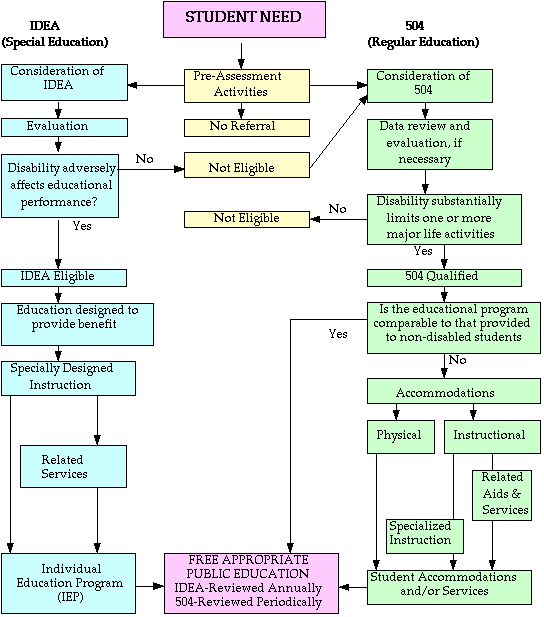
What are the difference between and IEP and a 504? Do general education interventions include modifications? How does this all include FAPE and IDEA? What does FAPE and IDEA mean for my child? There are lots of questions when you start discussing interventions for you child in school. Here are some of the answers.
image via: http://www.aspergerssociety.org/articles/72-Aspergers-and-Autistic-ChildrenHow-Does-a-504-Plan-Differ-From-an-IEP.htm

We should cover some definitions to understand the differences between plans so you can get the best education for your child.
IEP: Individual Education Plan; it outlines special education goals and services for your child as well as providers for those services.
Section 504 - This a section of a civil rights law, The Rehabilitation Act of 1973 that insures equal access to education, the disabilities can include physical and neurological disabilities. For examples of what kinds of disabilities are covered by IDEA and Section 504 refer to this link:http://www.ldinfo.com/idea504.htm
This is not the same as an IEP and the school doesn't get reimbursed for any measures outlined in the 504 plan.
IDEA is Individuals with Disabilities Education Act. It includes what must be in a child's IEP.
FAPE is Free Appropriate Public Education, and again is a part of  IDEA's disability law.

The simplest explanation I have found defining the differences between an IEP and a 504 plan is the following from the University of Kansas Medical Center website:
"A 504 plan is a legal document that outlines the accommodations needed by a student with a disability in order to have equal access to education. An IEP is an individualized, legal document that describes necessary accommodations, modifications and services for students with disabilities. IEPs provide the most intense and comprehensive support because schools receive additional funding to implement them. No funding is provided for general education interventions and 504 plans." - from: http://www.kumc.edu/cchd/fs_schoolsupports.html

image via:http://www.ldinfo.com/idea504.htm
The above handy flow chart is to help guide you through the process of getting your child's needs met in school. If given the option between your child having an IEP and a 504 plan, choose an IEP. A child with an IEP is covered by section 504 of the disability law. Know that your child has the right to a free and appropriate education under the law no matter what kind of accommodation or modification is needed.

Resources:
http://www.wrightslaw.com/blog/IEPand504
http://schoollawpro.com/freestuff/
http://www.wrightslaw.com/info/fape
http://www.wrightslaw.com/advoc/articles/504_IDEA_Rosenfeld.html


Monday, April 30, 2012

Federal Classroom Settings, Transitions and Mainstreaming

image via: http://loddymicucci.com/faith-transcends-your-limiting-beliefs/
My SensiGirl is in a Federal Setting 3 classroom. When that placement was brought up at her IEP last year, it made me cry. I felt like it was hopeless for her to get into a regular education classroom eventually. I felt like she was being restricted into a special education box and she wouldn't be able to get out. I had to do some more looking to find out more about what it really meant. This chart spells it out clearly what that means.

Federal Instructional Settings
School Age Students 6 through 21
01  Regular Class - less than 21% in special education classroom/setting
02  Resource or Self-Contained - 21-60% in special education classroom/setting
03  Separate Class - more than 60% in special education classroom/setting
04  Public Separate Day School Facility - more than 50% of day
05  Private Separate Day Facility - more than 50% of day at public expense
06  Public Residential Facility - more than 50% of day
07  Private Residential Facility - more than 50% of day at public expense
08  Hospital or Homebound Placement
Follow the link below for the full complement of settings including for children birth to 5:
http://specialed.spps.org/uploads/federal_instructional_settings.pdf

Federal settings have to do with how much time is spent in the regular education classroom, not the quality of instruction or if that setting is best for your child. You have to look beyond the label of "Federal Instruction Setting" to understand what it means for your child.

image via: http://www.thecrankymonkey.com/2010_02_01_archive.html

 It was explained to me that SensiGirl needed a special classroom to get her started out right in grade school. Simply put: if she became overwhelmed with the regular education classroom with 20 kids and all the noise and motion going on, she might not make the transition into elementary school without being traumatized. SensiGirl being like she is with a memory like a steel trap, if things went wrong, we might not get another chance to get it right. A separate classroom with only 10 other students and extra teachers as well as easy access to speech and occupational therapy specialists was what was in order for SensiGirl to get a good start in elementary school. She made the transition to her new school with the minimum possible upset for her, and she is now spending time mainstreamed in the regular ed. classroom during writer's workshop.
This is not to say that we got her in a regular education classroom with no hiccups. We were not very successful in our first attempt to introduce a regular ed. classroom to her. Breakfast and morning meeting was not her thing. She didn't like the transitioning within the classroom and didn't like crowding around the teacher with the other kids on the floor. The teacher tried to make it work, even having SensiGirl sit on her lap, but it didn't work. We had to find things she really liked, which were writing and drawing and introduce her to the classroom doing those things.

From Friends A Primer, (Pennell and Cusack, 1930’s)
image via:http://fithfath.com/images/?tag=classroom

We talked at her IEP last week about how to extend her time in the regular education classroom next year.  The transition into elementary school is a tough one for most special needs kids, making the transition as smooth as possible for them is the key, and then once they are used to their environment, you can start to test the possibilities of expanding their time in other settings.

resources:
http://specialed.spps.org/uploads/federal_instructional_settings.pdf

Monday, April 16, 2012

Decisions, Decisions...


image from: http://carseatblog.com/wp-content/uploads/2009/02/confused.jpg
I was at an advisory council meeting the other day, and a parent asked one of the administrators how they would know if their child needed a modified test. The administrator said to talk with the IEP team and maybe use a decision tree for that issue. Well, unless you are schooled in flowcharts, and use them to help you make business decisions, you might not think of a decision tree as your go-to choice making tool. Deciding about a modified test has more guidelines to follow and you need to track data on performance to show a need for a modified test, so I didn't agree with the administrator's suggestion. Decision trees are usually used to predict monetary risks and potential value. Keep in mind the adage: use the right tool for the right job.

image via: http://gautam.lis.illinois.edu/monkmiddleware/public/analytics/decision_tree.png
There are other graphic problem solving organizers to choose if a decision tree doesn't quite fit your needs. One way to sort out information and feelings about a decision is to use a T chart as a way of organizing your thoughts, this was a favorite of my Dad's, it's simple and effective with most decisions.
http://www.worksheetworks.com/pdf/3da/d1f58c578f533/WorksheetWorks_T_Chart_Graphic_Organizer_2.pdf
Now there are many ways to graphically organize your thoughts and help you sort out the information in making a decision. Here are  links to thumbnails and printables of several variations of graphic organizers including: Venn Diagram, Fishbone Diagram and something they call a decision making diagram which is a step up from the basic T-chart.
http://www.worksheetworks.com/miscellanea/graphic-organizers.html
http://my.hrw.com/nsmedia/intgos/html/igo.htm
You could also use a balance sheet as Ben Franklin did:
http://artofmanliness.com/2009/08/17/how-to-make-a-decision-like-ben-franklin/

You may also consider a flowchart. Although after looking at the link, you may not.  http://www.selectsmart.com/flowchart/

There is even a flow chart to help you decide if you need a flow chart
image via: http://www.enchantedlearning.com/graphicorganizers/gifs/flowchartall.GIF

One method I use is the T chart or Pro/Con Sheet.  Usually when I need to make a hard decision I do as my dad taught me and write it out pro and con on a T-chart. So remember, we not only do we have to find a way to make decisions ourselves, but we need to teach our children the art of decision making too. It is fortunate for us that we have so many graphic ways of displaying the options now, so it is easier for visual learners like many of our special needs kids to learn how to use them.
The whole idea of a graphic organizer is to take the information and get it out of your head and organized on a computer or paper. In organizing the information it may show you the answer or that you need more information to make the decision.


Maybe if this individual had learned how to use decision making tools she wouldn't have regretted asking this guy for 56 tattoos on her face.

image via: http://resources3.news.com.au/images/2009/06/20/1225737/969443-tattoo-trend-no-longer-a-black-artform.jpg


resources:
http://www.ehow.com/list_7232098_decision-tree-resources.html
http://www.decision-making-confidence.com/decision-trees-examples.html
http://gautam.lis.illinois.edu/monkmiddleware/public/analytics/decisiontree.html

Friday, March 30, 2012

Special Education Parents and Statistics: What You Need to Know


Image via: http://rlv.zcache.com/understanding_type_i_and_type_ii_errors_statistics_tshirt-p235935094802516345zvaki_400.jpg
We all have read on the Internet or in the newspaper articles about a study where a special diet is reported as helpful for ADHD or that taking antidepressants during pregnancy is linked to an increase in reported occurrence of autism in children. How about something as seemingly simple as measuring your child's progress at school? These all contain information relayed as statistics. Statistics are a way of using numbers to convey information in a usable way.

We need to know how to interpret the numbers in the studies to know if they were done using valid methods and if they are done in a way that is reliably measurable.
Firstly we need to know what kind of study it is. Is it a double blind study where the patients and the doctors don't know who is getting a medicine and who is getting a placebo? Is it a review of medical records and if so did the recorders of the records know ahead of time what the experimenters were looking for in the records? Is it a case study?
Next we need to know how big this study was, how many people were tested?  If it is a small number there is a large possibility for error.  Finally, does the conclusion of the researchers show a correlation or causation?

Here is an excellent summary of how to evaluate a medical study:
http://www.nurturedmoms.com/-evaluate-study/credible or crud

Aside from medical and psychological studies, we get statistics from our children's school. We get them in the form of report cards, achievement tests and IEP progress reports.
There are few articles online to help you with this; one reliable source is Wrights Law:
http://www.wrightslaw.com/advoc/articles/tests_measurements.html
This web page includes Educational Decision Making, General Principals of Statistics, Understanding Test Data and a Parent's To-Do List.  Knowing how to interpret the information you are given by school is important to know how to do. It can make a difference in how your child is educated.


There are also basic statistical books like Statistics for Dummies, Statistics Demystified and The Complete Idiot's Guide to Statistics.  The Complete Idiots Guide got the best reviews on Amazon. You might want to start with that one. They are worth checking out to brush up on your understanding of the information you are given by the media and your child's school.
http://www.amazon.com/Statistics-For-Dummies-Deborah-Rumsey/dp/0470911085/ref=sr_1_1?ie=UTF8&qid=1332953282&sr=8-1

http://www.amazon.com/Statistics-Demystified-Stan-Gibilisco/dp/0071431187/ref=sr_1_7?s=books&ie=UTF8&qid=1332953328&sr=1-7

http://www.amazon.com/Complete-Idiots-Guide-Statistics-Edition/dp/1592576346/ref=sr_1_1?s=books&ie=UTF8&qid=1332953570&sr=1-1

Image via: http://24.media.tumblr.com/tumblr_ljed9fByIi1qbu80io1_500.jpg
 What is all comes down to is learning the lingo, understanding what the words mean and what they are saying about the subject in the report you are reading.  Don't be afraid of statistics and numbers, they can be a great ally in trying to get something more for your child in school and out.

Additional resources:
http://www.npr.org/2011/03/12/134456594/study-diet-may-help-adhd-kids-more-than-drugs

http://abcnews.go.com/Health/Autism/antidepressant-linked-autism-study/story?id=13989498#.T3H8OGEgdCg

Friday, March 2, 2012

My Child Did What?

image from: http://i.ehow.co.uk/images/a04/s3/10/write-progress-notes-substance-abusers-800X800.jpg

At Random Guy's recent IEP and 3 year review meeting I was told he was going to lose some services.  I was not surprised but I was a little nervous. He is doing so well he doesn't need the extra help from the occupational therapist and speech teacher. He will be in the classroom almost the whole day now. The only pull out he has left is his social skills group. The rest of the help he will be receiving in class or in informal pull outs to catch up on any class work that he is behind in.
The school social worker said that when she interviewed him for the 3 year review he gave her the best interview she ever had with a student. She said in all her years she will probably never see an interview like that again. She was so impressed with his speech and how well he conversed with her.  I was so glad to hear all these wonderful things about my Random Guy.  Usually he is kind of a taciturn kind of guy. I also know that he will still need some extra help socially, so we all agreed to continue with the education plan, but to change the amount of services needed. This is from Random Guy's hard work as well as all the hard work that the teachers put in for Random Guy at his school.  This probably wouldn't have happened as quickly if we had stayed at the neighborhood school.
We moved Random Guy when he was going into the 3rd grade. He had been having trouble with bullying. He was physically bullied in kindergarten, 1st grade and 2nd grade. In second grade the teacher and principal were saying that the bullying was a two way street and that Random Guy was doing some verbal bullying too. Considering that Random Guy was reacting to being bullied for years, it was not surprising that he was misbehaving at school. My problem was how the school was handling it. The principal had changed that year, and she was much different from the previous principal. She was very abrupt and did not handle these things well. I struggled with the teacher and the principal for months over this issue.
When the school choice catalog came in the mail one week, I realized that it was time to try something different. I called the next door school and asked questions about bullying and their program specialists. If there was a speech teacher and occupational therapist on hand, would there be a way to work on social skills and so on. I got some good answers, but the best answer I got was when the school social worker didn't know the answer to one of my questions about bullying and went to the principal and got back to me within a day with the answer. They have a way of working with the kids so that bullying is taken seriously and not tolerated.  I registered Random Guy for the next door school and waited to see what would happen. We got the slot. It is a very popular school with waiting lists to get in at the Kindergarten level. In 3rd grade there was room for my guy.

image from:http://parentingbehavior.com/wp-content/uploads/2012/02/NoBully.png
I had some work to do with the teachers and social workers, but all the educators in that building believed in Random Guy and understood what a fun kid he was.  The neighborhood school only saw his deficits;  the next door school saw his possibilities.  Thanks educators for your hard work and faith in my Random Guy.

Wednesday, February 29, 2012

Accommodations, Modifications and Interventions: Words to Make You Wise

image from:http://4.bp.blogspot.com/-1MNHTMBTpys/To3SPjriTrI
/AAAAAAAAGv8/ZQBPkuLGhwY/s1600/teach.jpg
What are accommodations, interventions, and modifications? What are the differences between these? These words get thrown around during Individual Education Plan (IEP) meetings often. I know I have been confused about the differences at times. What about adaptations? What are those and how do they fit in?  Briefly stated, an intervention is defined by the Minnesota Department of Education as: " a proactive strategy for defining, teaching and supporting student behavior resulting in academic and social gains and a positive school environment."
Accommodations are defined as involving changes in instructional methods, including alterations in the format of assignments or tests, without changing content, that allows students with disabilities to do the same work as their typical peers in the classroom.
A modification is a change in the curriculum, for example assignments may be reduced in number. Accommodations and modifications are used in IEPs and 504 plans.
An adaptation is a change in the delivery of the lessons, the kind of accommodation or modification.  These terms are used interchangeably and sometimes incorrectly by both parents and educators.

 Accommodation                        Modification:                    
 No change to curriculum                        Change to curriculum                  
 Change in instructional methods           Alternative or reduced                        
                                                                     assignments


   Intervention:                        Adaptation
    Addition to cirriculum                   Change to delivery of 
    Data collected                                    instruction

Here is a link to a comparison guide: http://kirkwoodschools.org/upload/4b69f57e40578.pdf

You want to be familiar with these terms so you can make sure you have them written in the documents that detail your child's education plan. Some things to include may be:


Accommodations:
Schoolwork and homework broken down into small steps
Instructions for assignments presented orally and in writing
Written assignments read aloud to student
Graphic organizers used to present material visually
Small group or individual testing assignments
Use word processor for writing assignments
Additional breaks during class
Extended time for assignments

Modifications:
Homework assignments reduced
Focus on functional skills curriculum
Alternate math or reading curriculum at student’s level
Alternate tests will be used
Shortened writing assignments

Interventions:
Social skills group
Reward chart for assignment completion, behavior, etc.
Visual schedule
Access to a counselor, social worker or therapist
Tutoring for specific academic skills
Speech therapy, occupational therapy, or physical therapy

Adaptations:
Either an accommodation – change in the delivery without changing content,
or a modification – change of content


You can see how the actual help provided may be simple things but they must be documented. If you don't have it written down in an IEP or 504 then the teachers don't have to follow through with the changes to the learning environment needed to help the student get an education.  They may not do this because they don't know how.  This can also be addressed at the IEP meetings and meetings with your child's educators. This is why it is important to know which kind of change is being made and how it effects both the teacher and the student.

image from: http://schoollawpro.com/wp-content/uploads/2011/04/Accommodation1.jpghttp://schoollawpro.com/wp-content/uploads/2011/04/Accommodation1.jpg


resources:
modification info: http://www.washington.edu/doit/Stem/articles?83
accommodations: http://www.connectwc.org/definitions.html
interventions: http://rtiteacher.blogspot.com/2008/11/interventionsaccomodations-whats.html
accommodations, adaptations, modifications: http://www.uic.edu/orgs/stepup/documents/March2005stepupnewsletter.pdf
useful educational interventions: http://www.aane.org/asperger_resources/articles/education/educational_interventions_asperger.html

Special Thanks to SensiGirl's teacher for checking that I got this right.

Tuesday, February 28, 2012

The IEP files


image from: http://schoollawpro.com/wp-content/uploads/2011/04/Not-in-writing1.jpg

It is IEP (Individual Education Plan,) season in our house.  Random Guy is due for his 3 year evaluation and SensiGirl will have her annual IEP and 3 year evaluation in a month or so.
What is there to know about an IEP? Firstly it is a legal document, it is the school's obligation to follow what the IEP says and provide the resources to accomplish the goals contained in it.  It is an assessment of your child's progress, measurable goals and clear plans of how to achieve them. This is more than a report card, it is documentation of what goals were measured and progress of your child on those goals. Sometimes you IEP will include a behavior intervention plan. It is also a list of all the providers of services to your child: teachers, therapist, case worker, etc.

Make sure before going to an IEP meeting that you have the draft of the IEP being discussed at the meeting. Make sure you see all the changes in print before you sign it. This is for you and your child's benefit as well as the schools.  If it is not written as you agreed to then you can call another IEP meeting for changes and adjustments. They really don't want to have another meeting, so remind them of that if they put the pressure on you to sign at the meeting. Usually if there are changes the case worker will make the changes and give me a copy to read in the next day or so, then I will sign.

Watch out for unfamiliar jargon, if you don't understand an acronym or phrase, ask for clarification. I think that educators sometimes forget how many acronyms and buzz words they use.  Know what you want to ask for ahead of time. This is why it is important to get a copy of the document ahead of time. If you want some accommodations for testing, find a way for them to do that for your child.  If you think your child needs extended school year (ESY) address this subject before the meeting to lay the groundwork, and then bring it up at the meeting.

  An IEP is based on need, not availability of services. It is also an agreement for the use of resources to help educate your child. This will be expressed in frequency and amount of time for the support needed.
An IEP meeting doesn't have to be adversarial, but make sure that if your child has needs that the school should be providing support for, that it is written in the IEP document. If it isn't written in the IEP the school and staff don't have a directive as to what to do for that need. Everyone at the IEP meeting has a purpose for being there. They are there to give information, to monitor progress and to make sure protocol is being followed.  The whole point of an IEP is to find a way for your child to get an education and succeed at school.  Communicate your child's needs and expect the best from everyone on the team and more than likely you will get what you are striving for.

image from: http://2.bp.blogspot.com/-tGaIfl8SSoY/TkBKT-nh_aI/
AAAAAAAAD9w/Y4jY9WGu9Ps/s1600/IEP+for+aspergers+child.jpg


resources : http://www.wrightslaw.com/info/iep.draft.howey.htm

t shirt available at : http://www.zazzle.com/iep+gifts


Friday, February 10, 2012

Paper Monster Containment


image from: http://www.neat.com/blog/wp-content/uploads/2011/01/paper-monster.gif


I have a paper problem. I am hesitant to throw away documents that at some point and time where important. My sister calls it my **it problem. It is one of the three or four things The Atomic Punk and I still have arguments about it.  I stack the papers in a pile on a shelf or a desk and keep adding to it until it becomes a problem and I have to find a place for it.

When you have a child in special ed. you get a lot of important papers. Your IEP is a legal document and you will probably have to refer to it a few times a year.  The problem becomes where to put all these papers.
image from:http://www.sciencesurvivalblog.com/wp-content/uploads/2010/04/0511-0702-0211-2547_Businessman_Holding_a_Help_Sign_Up_Under_a_Pile_of_Papers_clipart_image.jpg

 When SensiGirl was first evaluated, her case worker gave me an expanding file folder to keep track of all the paperwork that was involved.  I went right out and got another one in a different color for Random Guy's stuff.  They have basic models for $6 at Walgreen's. It doesn't have to be fancy, but it is better if it is made of plastic to keep it sturdy. It helps if there is a slot for business cards too.
It is a place to put the copies of the evaluations, vaccination records, copies of birth certificates and the IEPs.  I take mine to every meeting I have with teachers or administrators at school.  I put all of the meeting paperwork in the folder as soon as I go to leave. This folder is also a place to keep examples of their work so that if anyone needs to see if they are capable of a certain skill, you could very well have an example of what they can do right there. Keep a notebook or paper tablet and some pens in there for good measure.
It is also a good place to keep copies of your Getting to Know letters, just in case your computer crashes, so you don't have to start from scratch. It can be a place for small keepsakes too, I keep the note I received from SensiGirl's preschool teacher after she completed preschool.  That thank you note helped me so much during her transition to Kindergarten.


Wednesday, February 8, 2012

Buzzwords, acronyms and other jargon


image from :http://60secondmarketer.com/blog/wp-content/uploads/2011/11/BuzzWord.jpg

Teachers sometimes speak their own language. We call it Eduspeak in our house. I am guilty of using myself.   It is sometimes used thoughtlessly as shorthand, shorthand for thoughtlessness or sometimes to intimidate parents into going along with the plan at hand. Below I provide the link to acronyms.com, some of the eduspeak doesn't come up at the top of the list, but its educational meaning is there in the list, just look for it. In testing it I tried the following:

ESY
SLP
IEP
IDEA
RTI

Try them yourself:  http://www.all-acronyms.com/

(For those in a time crunch the above are ESY -Extended School Year, SLP - Speech Language Pathologist, IEP - Individual Education Plan, IDEA - Individuals with Disabilities Education Act, RTI - Response to Intervention.

There is an extra dialect spoken at meetings by special education teachers, occupational and speech therapists and school administrators. Here are some humorous but handy links of what some of the buzzwords in special education mean:

http://www.illinoisloop.org/buzzwords.html

http://kidfriendlyschools.blogspot.com/2012/01/guide-to-eduspeak.html

You may want to try it yourself, just for fun.
Eduspeak Generator


Humor aside, what you need to do when talking with educators, is to not feel intimidated by the jargon and acronyms. Check your copy of the IEP for anything unfamiliar when it is handed out at the meeting. Speak up and ask them what is meant or to use different words. Ask for straightforward language or just plainly ask what XYZ means. Knowing acronyms and buzzwords is not a measure of intelligence. You can ask to take the IEP home and to read it again before you sign. You do not have to sign a document full of acronyms and jargon you don't understand.
If you don't know - ask!  If nothing else, it will make everyone take a moment in the conversation to help you grasp what they are saying about your child and how you can to plan for success together.


image from: http://www.zazzle.com/iep_t_shirt_tshirt-235467725162104343