Showing posts with label modification. Show all posts

Monday, May 20, 2013

Home School For Summer: Between Elementary and Middle School

My son, Random is going into middle school next year. We have several things planned for the transition, but more on that later. For the summer we had hoped summer school would be at the middle school he will be attending. Unfortunately, after our hopes were up, we were told that the location of summer school for the 5th going into 6th graders is not in his middle school. It is not even in our neighborhood. So rather that send him to summer school we will be attempting to home school again this summer. There is a lot less balking at the plan this year than there was last year. I have several books and programs we are going to work on during the summer months.

image via: http://www.staples.com/Typing-Instructor-for-Kids-Platinum-for-Windows-1-5-User-Download/product_954893
Firstly is a CD-ROM, Typing Island - Typing Instructor for Kids. It is also available as a download or as an app for the Mac. Random is going to have to boost his output for middle school and one way to do that is to use his computer to write up his papers. His handwriting is barely legible and he lost his OT handwriting help at his 9 year old reassessment.

image via: https://heartsathomestore.com/index.php?main_page=index&cPath=416_452
In order to address that lack of assistance at school I have also found the Getty Dubay Italic Handwriting series of books for teaching readable handwriting.
The school has done nothing to help him in this area since that reassessment and he still needs to work on letter formation, size and spacing.

image via: http://www.walmart.com/ip/1884933
The next item on our agenda is math review. He has really made improvements in math this year thanks to some adaptations and modifications to his math program. He is required to do only part of the problems on the homework worksheets and he gets homework help to review the day's lessons at the end of the school day. The combination of both has really made him more confident in his math skills. We have to keep the positive momentum going, so we are going to use Math Minutes.

image via: http://www.amazon.com/Comprehensive-Curriculum-Basic-Skills-Grade/dp/1609963350
Last year we used a comprehensive curriculum book. This year we will be doing the same with the Comprehensive Curriculum of Basic Skills for Sixth Grade. It has a nice overview of what to expect next year and some basic review pages too.

image via: http://www.dalebasler.com/2013/02/coding-to-learn-with-scratch/
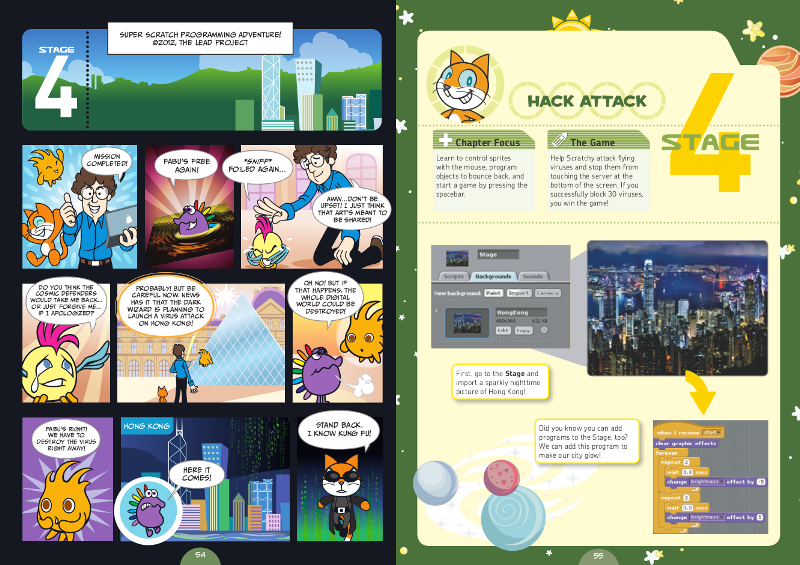
The part I am most excited about is the Scratch programming book I found. Super Scratch Programming Adventure. The format of the book is comic book style but it has real programming instruction to make games in the Scratch programming environment.

image via: http://www.carsondellosa.com/cd2/Products/GuinnessWorldRecordsReading/ResourceBook/104422
Lastly, we have The Guinness World Records Reading Grade 5. I figure if we sail through this one we can get another of that type from Amazon or from the Lakeshore Learning store.

So, that is our plan. I am hoping that Sensi's Extended School Year goes well and I won't have to pull her again this year. If it goes well for her I can spend some quality time with Random reviewing and prepping him for his big transition.

Monday, September 24, 2012

Pick Your Battles: Everyday Math

image via:  http://www.comicvine.com/myvine/cloverfield/all-images/108-400509/calvin_hobbes/105-1452730/ 
I have been fighting an ongoing battle with the school district over their insistence that Random Guy be taught Everyday Math at school. We have tried tutoring him at home with Singapore Math and Core Curriculum Math. He does better for a while and then starts falling behind as the exposure to Everyday Math increases. His confidence in his abilities plummets when it comes time to divide the class into different groups to teach math each year. He may not be as social adept as some kids but he know what the "s/low" group is and knows what it means.

image via:  https://www.facebook.com/pages/Parents-Against-Everyday-Math/37453309495?v=wall&viewas=0 

I had a meeting with his teacher, the school social worker and the learning specialist at his school today to come to an agreement about how to teach Random Guy math this year. I went with his most recent IEPs and his previous report cards in my green expanding folder.
I went in asking for him to be pulled out during math and a separate math curriculum. I explained that I had to reteach everything taught in class these past few years and that with two children having homework and therapies to go to I just don't have the time or ability to teach my son Everyday Math, every day, without any training. I explained that he is cognitively different than most of the other children and being so, needed mastery of a concept before being asked to move on to another one.

image via:  https://www.facebook.com/pages/Parents-Against-Everyday-Math/37453309495 

I left with a modification for less homework, an agreement that Random Guy would not be shuffled among the teachers and put into a "low" group and that the algorithms taught would be the standard ones not the loopy multiple ways Everyday Math has to solve the same problem. I was told the homework emphasis will be on the traditional algorithms and that the problems to be worked will be marked discretely on his worksheet or booklet, so there is no misunderstanding what work needs to be completed. I was assured that this was going to be the last grade that they will be using Everyday Math. Next year, for middle school there will be a traditional math curriculum.

Wait, what was your strategy?
image via:
http://www.wall321.com/Entertainment/TV_Series/david_tennant_
doctor_who_tv_series_1024x768_wallpaper_26513

Some would say that I didn't get what I was asking for, but really I think I got quite a bit. I got the modification spelled out by the learning specialist to the teacher. I got an agreement not to move my child from teacher to teacher to learn math, but rather stick with one teacher who now knows the modifications. There are 12 units this school year, so I kept Random Guy from having to move between three different teachers, two of which were not there for the meeting, and haven't got a clue about Random Guy.  I also got a chance to see what the reworked test format will be and what the standards are for the grade.
I got a meeting of the minds that Random Guy's teacher was going to follow the program. She also showed me how she is going to track his progress and increase the difficulty level of his work as he improves his performance.
image via:  http://www.specialeducationadvisor.com/top-ten-common-questions-about-special-education/ 

I sent a email (with a copy going to my husband,) thanking them for the meeting and outlining the agreed modifications and requested that the modifications be listed in his IEP.
It is best when faced with difficulties like this to find a way to solve the problem so your child gets the benefit of a modification rather than fight and fight and no movement occurs on their part for an adaptation or accommodation. It is a fine line to walk when advocating  for your child. You risk being viewed as helicopter parent, when really, experience has taught you to be proactive rather than reactive to save yourself and your child a lot of wasted time and energy.  Part of being a special ed. parent is having to teach the teachers every year. Part of being a special ed. parent is also learning from having to teach the teachers every year.

Wednesday, February 29, 2012

Accommodations, Modifications and Interventions: Words to Make You Wise

image from:http://4.bp.blogspot.com/-1MNHTMBTpys/To3SPjriTrI
/AAAAAAAAGv8/ZQBPkuLGhwY/s1600/teach.jpg
What are accommodations, interventions, and modifications? What are the differences between these? These words get thrown around during Individual Education Plan (IEP) meetings often. I know I have been confused about the differences at times. What about adaptations? What are those and how do they fit in?  Briefly stated, an intervention is defined by the Minnesota Department of Education as: " a proactive strategy for defining, teaching and supporting student behavior resulting in academic and social gains and a positive school environment."
Accommodations are defined as involving changes in instructional methods, including alterations in the format of assignments or tests, without changing content, that allows students with disabilities to do the same work as their typical peers in the classroom.
A modification is a change in the curriculum, for example assignments may be reduced in number. Accommodations and modifications are used in IEPs and 504 plans.
An adaptation is a change in the delivery of the lessons, the kind of accommodation or modification.  These terms are used interchangeably and sometimes incorrectly by both parents and educators.

 Accommodation                        Modification:                    
 No change to curriculum                        Change to curriculum                  
 Change in instructional methods           Alternative or reduced                        
                                                                     assignments


   Intervention:                        Adaptation
    Addition to cirriculum                   Change to delivery of 
    Data collected                                    instruction

Here is a link to a comparison guide: http://kirkwoodschools.org/upload/4b69f57e40578.pdf

You want to be familiar with these terms so you can make sure you have them written in the documents that detail your child's education plan. Some things to include may be:


Accommodations:
Schoolwork and homework broken down into small steps
Instructions for assignments presented orally and in writing
Written assignments read aloud to student
Graphic organizers used to present material visually
Small group or individual testing assignments
Use word processor for writing assignments
Additional breaks during class
Extended time for assignments

Modifications:
Homework assignments reduced
Focus on functional skills curriculum
Alternate math or reading curriculum at student’s level
Alternate tests will be used
Shortened writing assignments

Interventions:
Social skills group
Reward chart for assignment completion, behavior, etc.
Visual schedule
Access to a counselor, social worker or therapist
Tutoring for specific academic skills
Speech therapy, occupational therapy, or physical therapy

Adaptations:
Either an accommodation – change in the delivery without changing content,
or a modification – change of content


You can see how the actual help provided may be simple things but they must be documented. If you don't have it written down in an IEP or 504 then the teachers don't have to follow through with the changes to the learning environment needed to help the student get an education.  They may not do this because they don't know how.  This can also be addressed at the IEP meetings and meetings with your child's educators. This is why it is important to know which kind of change is being made and how it effects both the teacher and the student.

image from: http://schoollawpro.com/wp-content/uploads/2011/04/Accommodation1.jpghttp://schoollawpro.com/wp-content/uploads/2011/04/Accommodation1.jpg


resources:
modification info: http://www.washington.edu/doit/Stem/articles?83
accommodations: http://www.connectwc.org/definitions.html
interventions: http://rtiteacher.blogspot.com/2008/11/interventionsaccomodations-whats.html
accommodations, adaptations, modifications: http://www.uic.edu/orgs/stepup/documents/March2005stepupnewsletter.pdf
useful educational interventions: http://www.aane.org/asperger_resources/articles/education/educational_interventions_asperger.html

Special Thanks to SensiGirl's teacher for checking that I got this right.