Showing posts with label autism. Show all posts

Thursday, October 16, 2014

Tuesday, September 16, 2014

Taciturn Tuesday: Sensory Triggers

image via: https://scontent-a-ord.xx.fbcdn.net/hphotos-xfa1/v/t1.0-9/10620718_10101403855194988_6704324960028837994_n.jpg?oh=17b199ef02640a2d2e7fed584bf923f3&oe=548E6432

Tuesday, September 24, 2013

Tuesday, September 17, 2013

Taciturn Tuesday: Autcraft Fundraiser

image via: http://www.gofundme.com/3ow7hw


Plus

image via: http://my2.tupperware.com/tup-html/fundraiser.html
Equals


Monday, April 22, 2013

1 in 50? It is Time for Autism Advocacy

 
image by Jay Javier via: http://eastofherewestofthere.blogspot.com/2011/05/autism-accept-different.html

The big news this year for autism in April is that the emphasis has changed from Autism Awareness to Autism Acceptance. If your life has been touched by someone with autism, then you are plenty aware of autism. The newest study to come out is that the incidence of autism is at 1 out of 50 children will be diagnosed with autism spectrum disorder. 
 There has been enough media coverage of autism that I think acceptance is the important direction to follow. There have been many irresponsible stories about autism. Too many to cite here, one has been the vaccine debacle, which millions of dollars have been diverted from truly helpful research to proving a irresponsible "doctor" wrong. Another issue that seems to keep coming up is the media's fascination with linking mass violence with autism. They tried to make a connection with the Colorado movie theater shooter and also with the Newtown shooting. This is not only irresponsible it is dangerous. It is akin to bullying.
image via: http://ok.gov/sde/faqs/bullying-frequently-asked-questions
 Most individuals with ASD (autism spectrum disorder,) have been bullied. Not only that but since they may lack the social skills or language to report it, it often happens repeatedly before the proper authorities have been made aware of the situation. The proper authorities have to be educated on how to deal with bullying of ASD individuals properly. People living with autism can expect to be bullied repeatedly over the course of their lives. It is imperative that we teach our children to report when they become targets for bullies. 
image via: http://www.frameworks4learning.com/workplace-bullying.html
 It is very important to learn to advocate and to teach our children how to advocate for themselves and to be resourceful in their dealings with those who would like to take advantage of their situation.
So I would propose that we not just focus on awareness, or even acceptance but advocacy for ourselves and our children. 

http://bigstory.ap.org/article/health-officials-1-50-school-kids-have-autism

Friday, September 14, 2012

Reappraisal: An important skill

What emotions do you see when you look at these faces?
image via:  http://news.bbc.co.uk/2/hi/health/7041164.stm 

image via:  http://www.pbs.org/wgbh/pages/frontline/shows/teenbrain/art/fear1.jpg 
According to studies, most typical teenagers interpret it as shock or sadness when really it is fear. When your kid is saying they are afraid you will be upset at them for doing something...it may be this face they picture.
Misinterpreting emotions on faces is not just something that kids and adults with ASD (autistic spectrum disorder,) have trouble with. Children and teenagers wrestle with it too. There are numerous emotion/nonverbal communication and social apps and computer programs designed to teach individuals with autism the facial expressions of emotions. Its not only facial expressions that they have trouble with, it is also judging whole social situations.  Interpreting situations that they find troubling are challenging to individuals on the autistic spectrum. They may just ignore their feelings, rather than analyzing the situation to come up with a more plausible conclusion. This is the piece of social interaction that needs to be dealt with and taught instead of endlessly quizzing your child on other's expressions or to constantly remind them to make eye contact.

The Four Forms of Reappraisal
image via:  http://anders.janmyr.com/:
"Notes on Your Brain at Work"
Stanford researchers find that ASD individuals use less effective emotional regulation strategies than neurotypicals. Many use suppression of feelings rather than use reappraisal of situations in interpreting social interactions. This is the key to successfully dealing with others in social situations. It's not the misreading of faces, its what you do with the information. What other information is available to support the reaction? What other possibilities are there to explain the interaction. It's looking at the whole scenario rather than focusing on the minutia of perhaps culturally and individually variable facial expressions and verbal responses.
image via:  http://www.sitkins.com/blog/bid/41347/Office-Politics-Does-it-have-an-impact-on-your-results 

Reappraisal is important because you work through the possibilities of the problem to get to an acceptably plausible answer. If your friend doesn't acknowledge you when you greet them, it can be perceived as a snub, and then you suppress your hurt feelings, or you can reappraise the situation as maybe they were distracted or busy or didn't notice you said something. More often the ASD individual will attribute it to the negative interpretation and stuff hurt feelings rather than working through the social possibilities and coming up with the more socially and emotionally comfortable answer that the friend may have been busy and not noticed the greeting.

image via:  http://s3.cinemagnetics.com/artwork.html

If the goal is to teach useful skills for life, putting the emphasis on reappraisal rather than recognizing facial expressions may be the most beneficial way to go. Teaching emotions is important, especially to help your child label their own emotions and have some idea of how others feel. Teaching possibilities, and flexible thinking is even more important.


Source:
http://nesca-news.blogspot.com/2012/08/stanford-researchers-investigate.html
http://anders.janmyr.com/2012/05/notes-on-your-brain-at-work.html
interview with Deborah Yurgelun-Todd
http://www.pbs.org/wgbh/pages/frontline/shows/teenbrain/interviews/
http://blog.autismspectrumdirectory.com/2011/01/14/ipad-ipod-touch-and-iphone-apps-non-verbal-and-social-communication-by-body-language/

Monday, May 7, 2012

Explaining Autism: Neighborhood Kid Version

image via: http://www.autismpakistan.org/
The other day, Random Guy's neighborhood pal was over to play. Pixie wondered why there were carabiners on the gates to the back yard. Random Guy explained it is to keep his sister from running out into the street. He explained she doesn't pay attention to the cars going by in the street and will just run out without looking.
Pixie then asked if SensiGirl has a disease that caused her to be like she is. I heard no answer coming from Random Guy, just uncomfortable silence. In fact Pixie asked the question of him twice. He declined to answer. I had to get on with what I was doing, but it made me think.
image by: www.explainautism.com 
How do I help Random Guy explain his sister to his friends? His regular play date buddy has autism, so there is no explaining there. He met another one of his friends while we were at Theraplay for SenisGirl. Random Guy is on the spectrum, but we have explained his differences to him as having a brain that works differently than most others do. I have explained his sister to him that way too, and to a lesser extent his Mom and Dad.  I also explained sometimes his difference is why he has trouble with bullies. When he has asked directly if he has autism, I explained he doesn't have a speech delay, so it is called Asperger's, but really it's more of a visual way of thinking. I joke with him about how his attention to detail is a super power.
When he has asked about his sister, I told him she has autism, and it means she is having some difficulty with acquiring speech. I also explained how autism is what makes her so good at music and drawing and helped her learn how to read earlier than most others. I also explained how her autism makes her very sensitive to her environment and so we do things differently sometimes to make things easier for her.  I told him we do things like take her to speech and occupational therapy to help her adjust to the world around us.
image by:www.explainautism.com 
We have never as a family been asked such a bald-faced question as, "Does she have a disease that makes her like that?"  How do you explain to a 9 year old what a neurological difference is when they don't have the difference themselves? It was easy to explain to Random Guy because I pointed out examples of the way he was and how that is different than most. I also explained that difference makes him special. His visual memory is like a super power or a gift he has to use at his will.
Explaining this to other children directly wasn't something I have had to do. Usually I am better acquainted with my Random Guy's playmates' parents. I have only had to explain to them and they all were very understanding and seemed to get it. In fact Pixie's mom and I had several discussions about diagnoses and the schools we chose for Random Guy and SensiGirl. She told me she thought  Pixie's sister may have some of the hallmarks of Asperger's too.
 I am contemplating calling her mother to enlist some help in explaining.  Perhaps that is why Random Guy's friend, Pixie is so willing to play with Random Guy. He is familiar to her as her sister.
image by: www.explainautism.com  
special thanks to: http://www.explainautism.com/

Friday, April 13, 2012

Correlation, Causation and "Links"


What does it mean when a medical study shows correlation? Does it show cause and effect? What about causation? What does it mean when the media announces another "link" to autism? What about those confounding variables. There are some words we need to define before we delve any further into the world of statistics, media and hype.


image via: http://www.rimmkaufman.com/content/bell_curve2.gif


Causation- The action of causing, as in the relationship of cause to effect, something that produces an effect.  "Even when you change something, you cannot remove the effect without removing the cause."
Correlation- the degree in which two or more measurements on the same group of elements show a tendency to vary together. Just because they vary together you cannot assume causation.
Link- this is not a statistical term, it is used by the media to show a relationship.
Statistically significant - generally, the result would happen by chance less than 5% of the time.
Confounding variable/factor - something that correlates either negatively or positively with the independent and dependant variables.
image via: http://www.experiment-resources.com/correlation-and-regression.html
What we are looking for in these studies is cause and effect. The recent report about the "link" between obesity and autism is more hype than science. What they found was a correlation between having children with autism and women having diabetes. Women who were overweight were more likely to have metabolic disorders, defined in the study as obesity, diabetes and hypertension. The reports of the study focused on women, obesity and having a child with autism, instead of diabetes. Although diabetes had a correlation that was statistically significant in the findings, the correlation of having a child with autism to hypertension and obesity was not statistically significant, meaning that it did not occur more than it would by chance. Obesity was not cited specifically as a correlative or causative factor. Obesity is generally defined as having a BMI score of over 30. (I did not find out if they used this exact measure.) 
What about regular weight women with diabetes and hypertension? Do they have a higher risk of having children with autism? How do they fit in with these findings? The sample pool was over a thousand children, and still they only found a "loose association," to metabolic disorders, (as the study's writers put it.) This tells us that they are not very confidant with their results or they would have stated it differently.  It does point to an interesting direction for more research, but as it stands it doesn't say much and it is difficult to tell if there is a confounding factor involved.
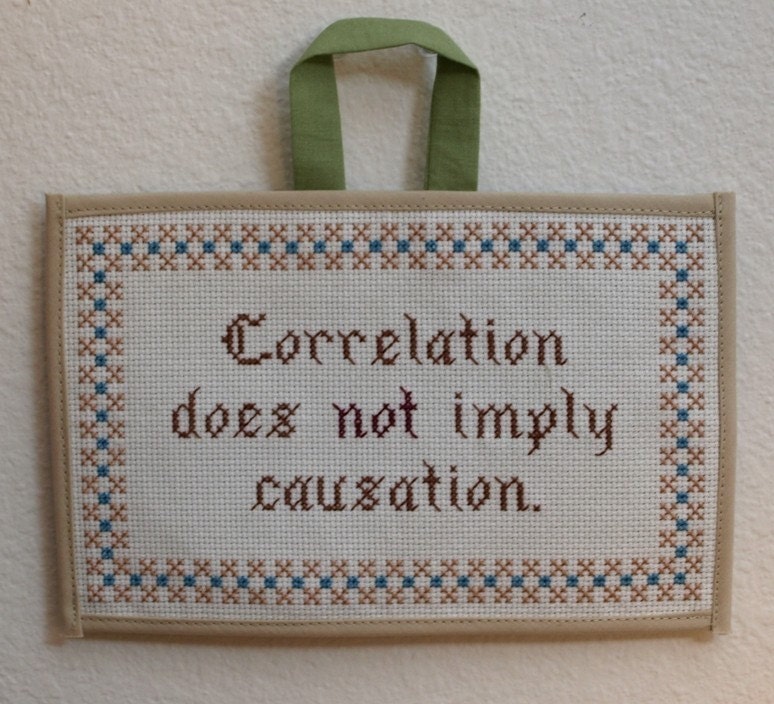
There are many factors involved a child being diagnosed with autism.  Another report stated recently that older fathers (they defined older as over 35,) had a greater likelihood to have children with autism.  If you look further you see that "greater likelihood" is really a correlation not causation, and that the three small studies involved are again showing possible directions for more research, rather than an answer to the question: Do older fathers have more if a chance of having children with autism?

image via:http://www.etsy.com/listing/45771938/correlation-does-not-imply-causation

We as parent and media consumers need to be savvy to the use of statistics in media reports, especially ones announcing the latest cure or cause for autism, (or the special need your child has.)  Read the reports with a critical eye and keep these definitions in mind.  As I have said, statistics aren't scary, but they can be a powerful tool to either instill confidence or fear.  I hope this post helps make things clearer and less fearful for you.


Resources:
http://pediatrics.aappublications.org/content/early/2012/04/04/peds.2011-2583.abstract


http://www.eurekalert.org/pub_releases/2012-04/uoc--mod032812.php


http://www.cbc.ca/news/health/story/2012/04/05/autism-genetics.html


http://www.nimh.nih.gov/about/director's blog/2012/the-new-genetics-of-autism


http://www.av8n.com/physics/causation.htm


http://dictionary.reference.com/browse/causation


http://dictionary.reference.com/browse/correlation?s=t
Statistics Demystified by Stan Gibilisco
Statistics for Dummies by Deborah J. Rumsey

Wednesday, February 22, 2012

The Basics of Social Stories


image from: http://blog.friendshipcircle.org/wp-content/uploads/2012/01/
First-Then-Strips-300x289.jpg


Social stories are a sequence of pictures and word that explain the order of events in an activity. At the most primary level they start with first/then stories. These are very helpful to kids who have autism. They can see what is going to happen next.

You can look on You Tube or check out Teacher Tube for video social stories to show your child when you are going to do something new or are teaching social expectations. We used Teacher Tube for the going to the movies social story.
http://www.teachertube.com/googleSearch.socialstory


Fire Drill
image from: http://www.goodreads.com/book/photo/7528667-fire-drill 


You can also find social stories in book form like Fire Drill: http://www.goodreads.com/book/show/7528667-fire-drill


Of course there is an app or two for that:
image from http://a5.mzstatic.com/us/r1000/024/
Purple/e1/03/2f/mzl.rizctbkc.320x480-75.jpg

http://www.modelmekids.com/ Model Me Kids has several useful scenarios, getting a haircut, shopping at the mall, going to the doctor and more.

image from http://www.look2learn.com/files/
stories2learn-icon-transp-2.gif

http://itunes.apple.com/us/app/stories2learn/id348576875?mt=8
We have the old version of Social Stories from Look2Learn, so I am not sure about any updates.  Look2Learn.com has several apps that are helpful with scheduling and social learning.

When it comes down to it, if all you have is a piece of paper and a pencil you can write a social story that will be helpful in letting your child know what is going to happen when you do something new. This helps prevent meltdowns since you are making the sequence of events known and you are setting the expectations for the behavior while doing the activity.  Most kids like to know what is going to happen.  Here is a great example; even if it is in French you get the idea:

image from: http://2.bp.blogspot.com/_qerOqlTbYI4/S-V1KEBu-iI/
AAAAAAAAAMM/q2DX712xmJM/s1600/social+story+1.JPG

Here are a couple of great blog posts from the above social story writer about traveling with a kid who has autism:  http://paris-ankara.blogspot.com/2011/05/social-story-for-travelling-by-plane.html

Social stories have been very helpful for our family. We don't use them nearly enough, but when we do it reminds me how powerful they can be.


Saturday, February 18, 2012

Sensory Saturdays:Cinema and Theater

image from: http://beta.images.theglobeandmail.com/archive/00862/sensations06lfA
__862223gm-a.jpg

Sensory friendly films at AMC!  SensiGirl saw her first movie there. It was a bit difficult for her, but once we got past the wait in the atrium and got her headphones on she was engrossed with the film! We haven't gone back since the summer. But there haven't been any titles that are up her alley lately. If you want to share the fun of the movies with your kids, (and not be stuck at home with DVDs or Netflix,) and be a part of the social experience of going to see a show together, these shows are the way to start. We showed SensiGirl a social story about going to the movies before we went:
http://www.teachertube.com/viewVideo.php?title=Going_to_the_Movies___A_Video_Social_Story&video_id=70684

 At a sensory friendly film it is lighter and quieter than how they regularly play the movies. The audience is all families who have experience with sensory issues, so they are as understanding of your child as you are of theirs. Know the audience will not be quiet. See if an upcoming movie is in your future. http://www.amctheatres.com/SFF/

image from:http://www.amctheatres.com/uploadedImages/Program
and_Offers/Featured_Pods/sff_342x143.jpg?n=5475

Here are some sensory tips we found helpful: bring ear protection, make sure you have told/shown a social story to your child a few days or weeks ahead of time. Bring extra adults if you can and if you are going as a family, take separate cars, so your other children won't miss out on the fun if your sensitive child can't handle it the first time. Go try it out, the thing about having a child with challenges is you have to push a bit all the time. Sometimes the push and the carrot are one in the same.


photo by: Dan Norman

Children's theaters around the country are also good for this kind of experience. We haven't gone with SensiGirl yet, but Random Guy has been with school for a field trip.  This article from the Seattle Repertory Theater about a child at the Children's Theater performance of Harold and the Purple Crayon made me so happy. I posted the note below but it may be easier to read if you follow the link.

http://www.sharetheatre.org/tag/harold-and-the-purple-crayon/

image from:http://files.campus.edublogs.org/blogs.belhaven.edu/dist/0/27/files/2012/02/421978
_3169297516033_1373317630_3311613_1523329951_n-27xls3v.jpg

So try something new, if you take little steps, your child can experience some of the wonder of the theater and cinema. You just might have a good time too!


image resource: http://thesensoryspectrumblog.com/2012/01/26/spd-not-the-diagnosis-du-jour/


Saturday, February 4, 2012

We Have an App for That


SensiGirl has communication delays. In preschool they used a Dynavox communication device. We decided to get her an iPad to keep her communication device tied to her not the classroom. We have tried all kinds of apps. Some are helpful, some are fun and some have not really been that useful. We did get the Proloquo2Go communication app. I think I may write a whole entry on that one later.

  I have a couple of places that I go to find new apps for her iPad. Of course I go to the app store and do searches for autism, communication, social stories, language/speech acquisition and emotions/feelings.  My go-to outside of Apple resource is this site:

iPad Apps and Resources for people with Autism
This spreadsheet is compiled by a parent, an adult with autism and a speech language pathologist. They usually update it monthly.

Another place to look for apps is at Autism Speaks:

That being said, the latest apps we have been using are:

 Feel Electric from the Electric Company, lots of facial expressions and the feelings labeling them in this app.

Of course an iPad can't all be about therapies and autism apps. There has to be some fun and regular kid stuff too.  Shoe the Goose is a great company for fun family apps.


SensiGirl is an avid drawing artist so we have found a couple of drawing boards. She likes the absolute board the best; and its free!


I will periodically post what we have new on our iPad. Let me know if you have any suggestions too!